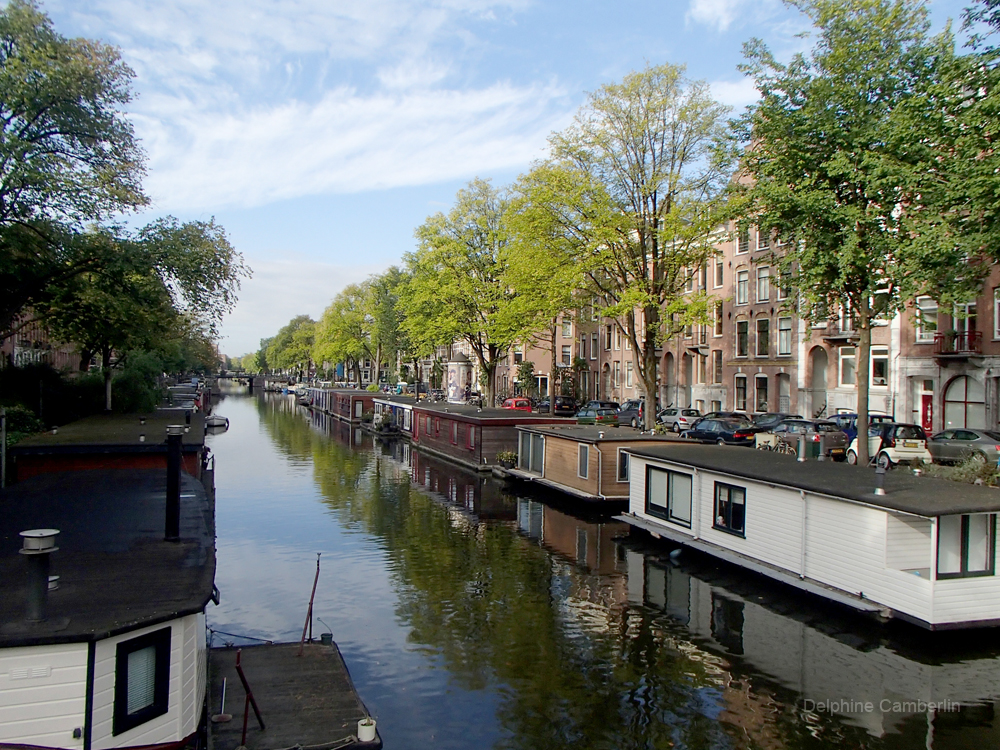
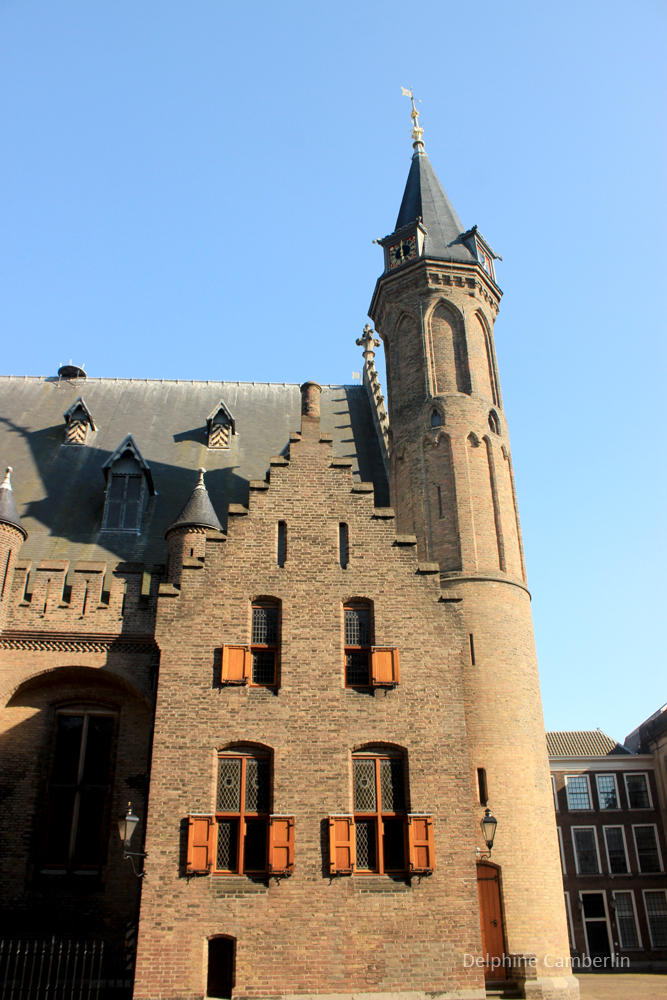
The Netherlands is a country of deceptive depth. Amsterdam's canals and the Rijksmuseum are justly famous, but the country rewards those who look beyond the capital. Rotterdam's extraordinary contemporary architecture — one of Europe's most ambitious skylines, built almost entirely after WWII — shares almost nothing visually with the medieval quietness of Utrecht or the storybook windmills of Kinderdijk. The tulip fields of the Bollenstreek in April are as overwhelming as they look in photographs. The Veluwe forest is a landscape most visitors never reach. And everywhere — on every road, in every city, through every village — the Dutch cycle. Not as a tourist activity, not as exercise, but simply as the way people move. There is also something quietly extraordinary about the ground you're standing on: around 26% of the Netherlands lies below sea level, and without one of the most sophisticated water management systems ever built, all of it would be underwater. The windmills you see aren't just decorative icons — they were, and some still are, the pumps that keep the country dry.
The Randstad is the densely connected urban ring that forms the economic and cultural heart of the Netherlands — Amsterdam, Rotterdam, The Hague, and Utrecht, bound together by one of the world's best rail networks and separated by the Green Heart (Groene Hart), a polder landscape of meadows, ditches, and grazing cattle that somehow survives between four major cities. Amsterdam itself is one of Europe's most layered capitals: the canal ring (a UNESCO World Heritage Site), the Jordaan neighbourhood's narrow lanes and brown cafés, the Rijksmuseum's Vermeer and Rembrandt collections, the Van Gogh Museum, the sobering intimacy of the Anne Frank House, and the Negen Straatjes (Nine Streets) boutique district. But Amsterdam also rewards those who simply walk without a plan — along the Prinsengracht in the early morning, or through De Pijp neighbourhood at market time.
Beyond Amsterdam, the Randstad's other cities each have a distinct character worth at least a day. Haarlem — 20 minutes by train — has Frans Hals Museum and a beautiful medieval centre. Delft is smaller and quieter, with its iconic blue pottery workshops and Vermeer's birthplace. The Hague (Den Haag) is more formal, home to the Mauritshuis (Vermeer's Girl with a Pearl Earring) and the quietly excellent Escher Museum. Leiden is a university city of canals, windmills, and the oldest university in the Netherlands — with a charming slower pace.
The Netherlands is perfectly set up for independent travellers. The NS national rail network connects every significant town with frequent, reliable trains, and the OV-chipkaart gives you seamless access to trains, trams, buses, and metro across the entire country on a single card. Amsterdam is one of Europe's more expensive cities, but day trips to Haarlem, Delft, Utrecht, and Leiden offer comparable beauty at a fraction of the cost. And unlike anywhere else in Europe, the bicycle is not just an option — it is the dominant mode of transport for everyone, at all ages, in all weather. Hiring one for a day transforms the experience.
| 🗓️ | Recommended stay | 5 – 10 days |
| 🎒 | Budget / day | €60–90 / $66–99Hostel, market food, OV-chipkaart transport |
| 🥂 | Luxury / day | €180–350 / $198–385Canal-house hotel, canal boat hire, tasting menus |
| 📅 | Best months | April – May (tulip season) · June – September |
| 🌡️ | Climate | 3–22°C · Temperate maritime · Rain possible any monthAlways pack a light rain jacket — even in July |
| ✈️ | Visa | Schengen — EU / EEA free · US / UK visa-free 90 days |
| 💵 | Currency | EUR · Cards everywhere including most market stalls · Contactless universal |
| 🚲 | Getting around | Bicycle is king · NS trains excellent between cities · OV-chipkaart for all public transport |
| 🛡️ | Safety | Low — very safeWatch your bike (lock it properly!) and pockets in central Amsterdam |
| 🍜 | Must-try food | Stroopwafel, bitterballen, fresh haring with onions from a market stall, Dutch aged cheese (aged Gouda), poffertjes, rijsttafel (Indonesian feast — a Dutch-colonial legacy) |
| 💬 | Language | English spoken fluently by virtually everyone — one of the highest English-proficiency rates in the world |
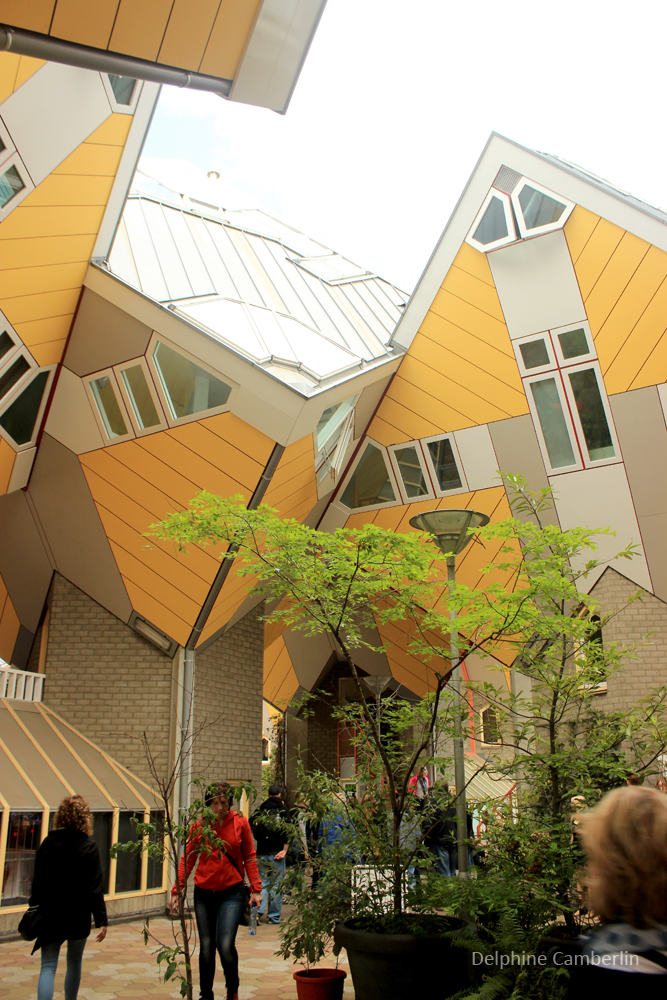
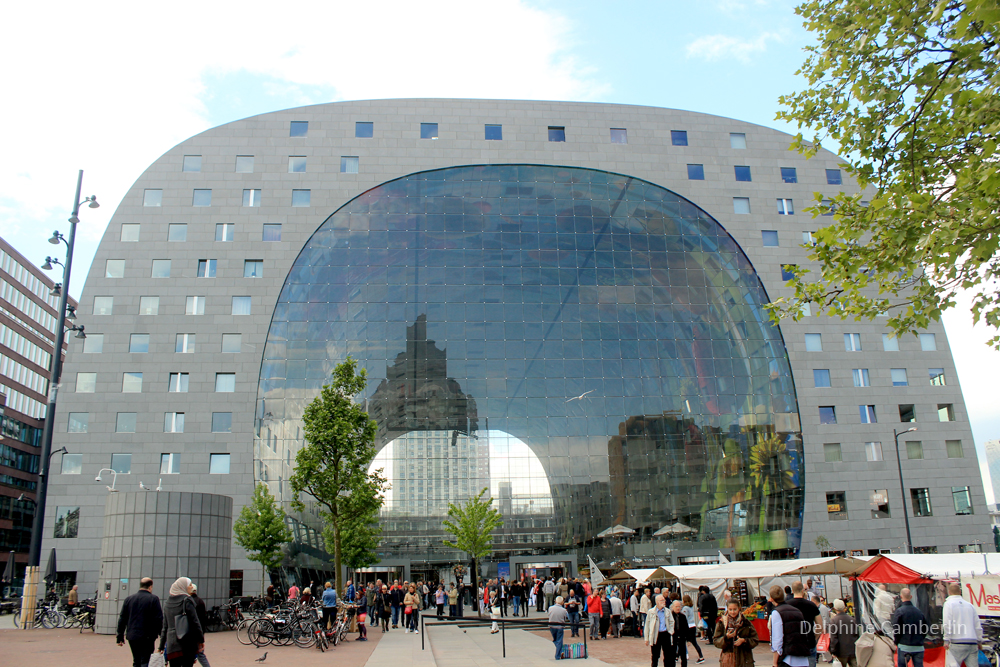
Rotterdam was almost entirely destroyed by German bombing in May 1940, and the Dutch chose to rebuild it not as a replica of what was lost but as a laboratory for contemporary architecture. The result is one of Europe's most striking skylines: the Erasmus Bridge (nicknamed the Swan), the Markthal — a vast arched market hall with a 11,000 m² ceiling mural — the Cube Houses designed by Piet Blom, and dozens of other bold structures within comfortable walking distance of each other. It is the polar opposite of Amsterdam's historic atmosphere, and both are worth your time.
South of Rotterdam, Zeeland is the Netherlands' most aquatic province — a complex mosaic of islands, estuaries, and sea inlets shaped by centuries of flooding and reclamation. This is where the Delta Works were built following the catastrophic 1953 North Sea flood, which killed over 1,800 people. The Oosterscheldekering storm surge barrier — a 9-kilometre moveable barrier with 62 massive steel gates — is one of the great engineering achievements of the 20th century and is listed as one of the Seven Wonders of the Modern World. You can drive across it, and the visitor centre explains the full extraordinary story of how the Dutch relationship with water was transformed by a single night's disaster.
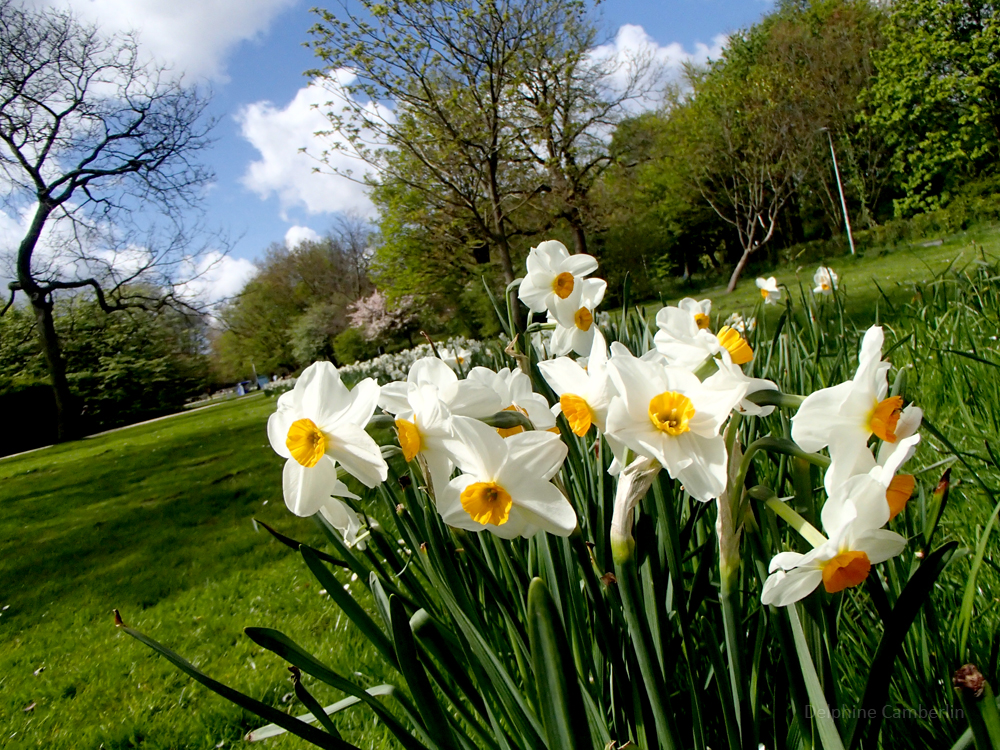
● Keukenhof in April — 7 million bulbs in bloom across 32 hectares, near Lisse. It's as overwhelming as it sounds. The challenge photographically is finding compositions that go beyond the obvious rows of colour — look for the transition zones where different fields meet, shoot at opening time before crowds arrive, and use the reflection pools for mirror images. Buy tickets online well in advance; the park sells out.
● Amsterdam's canals in autumn — the combination of reflected canal houses, fallen leaves on the water, and the characteristic soft Dutch light makes October the finest month to photograph the city. The Jordaan neighbourhood at dawn, before the tourist boats begin, is the quietest and most atmospheric. The Rozenhoedkaai view looking toward the Westerkerk tower at dusk is one of Amsterdam's iconic compositions.
● Rotterdam's architecture — one of Europe's most striking cities for contemporary architecture photography. The Erasmus Bridge at blue hour, the Markthal interior's painted ceiling from below, and the Cube Houses from the street below all offer completely different photographic challenges within 15 minutes' walk of each other.
● Kinderdijk at sunrise — nineteen windmills in a row reflected in the polder water, with mist still on the fields. Arrive before 8am in spring or summer and you often have the place almost to yourself. By 10am the tour groups arrive. The light on the windmill sails as the sun comes up is worth the early start.
● The Hoge Veluwe & Veluwe forest — the largest national park in the Netherlands, covering heathland, forest, and shifting sand dunes in Gelderland. The park provides free white bicycles at the entrance — one of the best ways to move through a forest landscape I have found anywhere. Wildlife is abundant: red deer, wild boar, and the extraordinary Kröller-Müller Museum sits in the middle of the trees, housing one of the world's finest Van Gogh collections.
🎟️ GetYourGuide: "Experiences I'd book in the Netherlands: a Keukenhof day trip from Amsterdam in April, a Kinderdijk windmill tour by waterbus from Rotterdam, a canal boat evening in Amsterdam, and a Delta Works guided tour in Zeeland."
Utrecht is the Netherlands' fourth city and one of its most underrated — a medieval university city of extraordinary canals (the split-level wharves are unique in Europe, with cafés and restaurants built into the arched cellars below the street), a towering Gothic cathedral, and a student energy that keeps it lively year-round. The Dom Tower is the tallest church tower in the Netherlands; on a clear day the view from the top reaches Amsterdam. Utrecht is also a major cycling hub — the Hoog Catharijne station is reportedly the world's largest bicycle parking facility, with space for over 12,000 bikes.
Eindhoven, an hour south of Amsterdam by train, is the Netherlands' design and technology capital — home to Philips (which essentially built the city), the Design Academy, the Dutch Design Week (the largest design event in Northern Europe, held each October), and a thriving creative scene that makes it feel increasingly essential. The Strijp-S district — a vast former Philips industrial campus converted into studios, galleries, and music venues — is one of the finest examples of industrial urban regeneration in Europe.
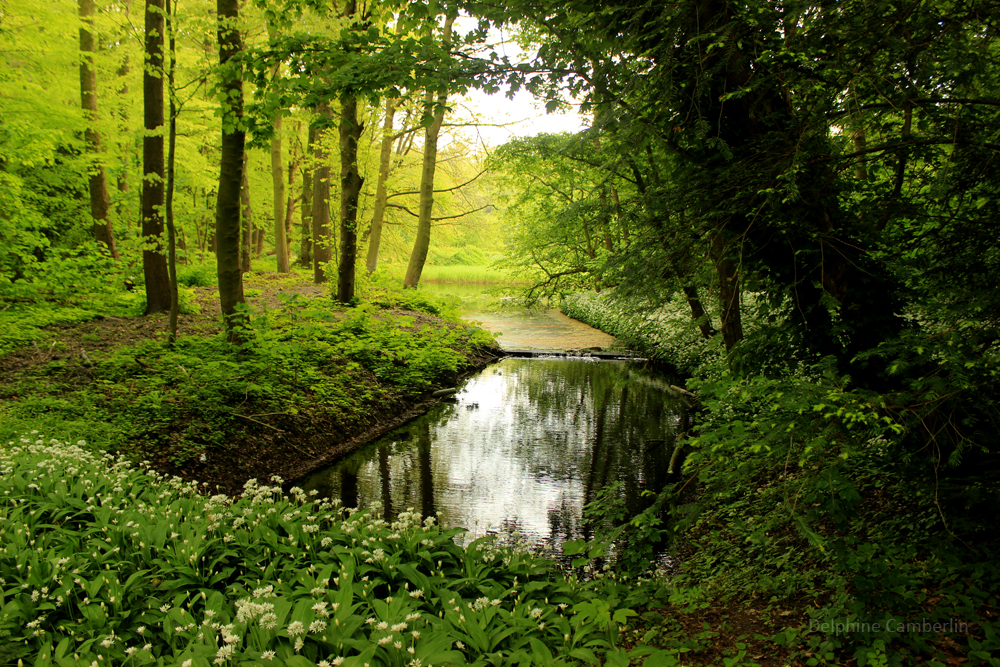
The Veluwe is the largest forested nature area in the Netherlands — a vast landscape of heathland, pine forests, and shifting sand dunes in the province of Gelderland, covering over 900 km². It comes as a genuine surprise to visitors who associate the Netherlands entirely with flat polders and canal cities. Hoge Veluwe National Park, at its heart, offers some of the finest cycling and hiking in the country, and is home to red deer, wild boar, and the extraordinary Kröller-Müller Museum — one of the world's largest Van Gogh collections, sitting improbably in the middle of the trees with a sculpture garden to match. The park provides free white bicycles at the entrance for visitors to use — take one and disappear into the forest.
Apenheul Primate Park, Apeldoorn — one of the most extraordinary wildlife experiences in Europe, and unlike any other zoo I have visited. Founded in 1971 as the world's first park where monkeys roam entirely freely among visitors, Apenheul houses over 35 species of primate in a forested setting where the animals come to you, not the other way around. The ring-tailed lemurs — critically endangered in Madagascar — show no fear of humans and will hop onto your arm or shoulder as naturally as if you were a tree branch. Squirrel monkeys drift overhead through the canopy. Tamarins investigate pockets. Gorillas and bonobos are in large enclosures, but the smaller species simply share the paths with you. It is genuinely magical in the way that very few wildlife encounters are.
Sleeping in the forest — eco lodges on the Veluwe — the Veluwe has developed a range of exceptional nature accommodation options for those who want to wake up to deer outside the window rather than a city street. Park Berkenrhode (near Wekerom) offers fully gas-free eco lodges built with solar panels and sustainable materials, set in private forest clearings. Huttopia De Veluwe near Apeldoorn offers Canadian-style cabin glamping in the trees — a perfect base for cycling into Hoge Veluwe and visiting Apenheul. Several luxury treehouse rentals are also available through platforms like Glampings.com — spending a night elevated among the Veluwe pines, with owls calling at dusk, is a completely different Netherlands to Amsterdam's canal houses.
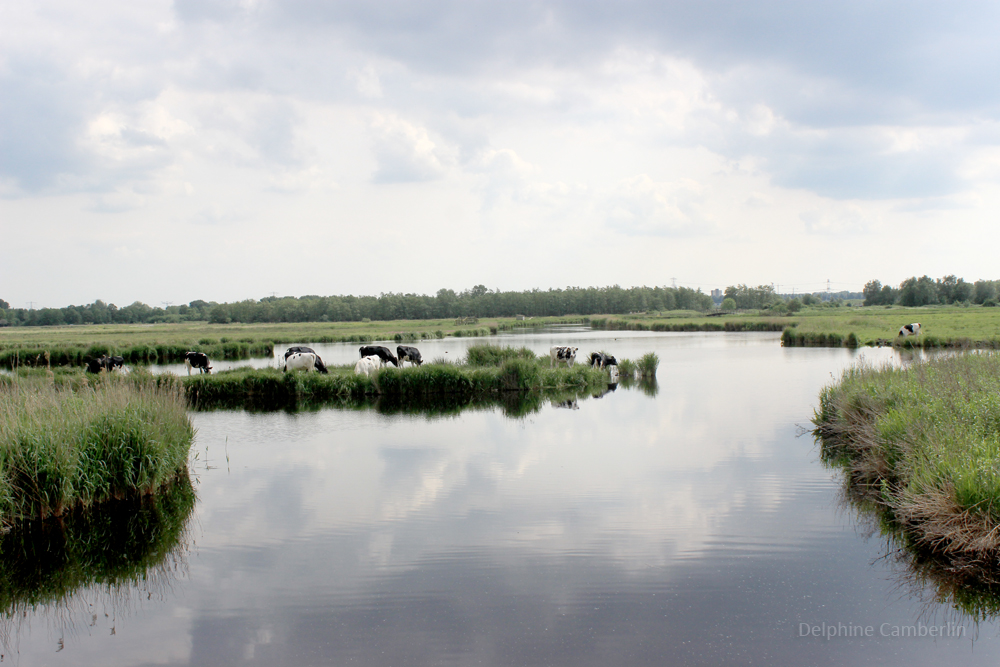
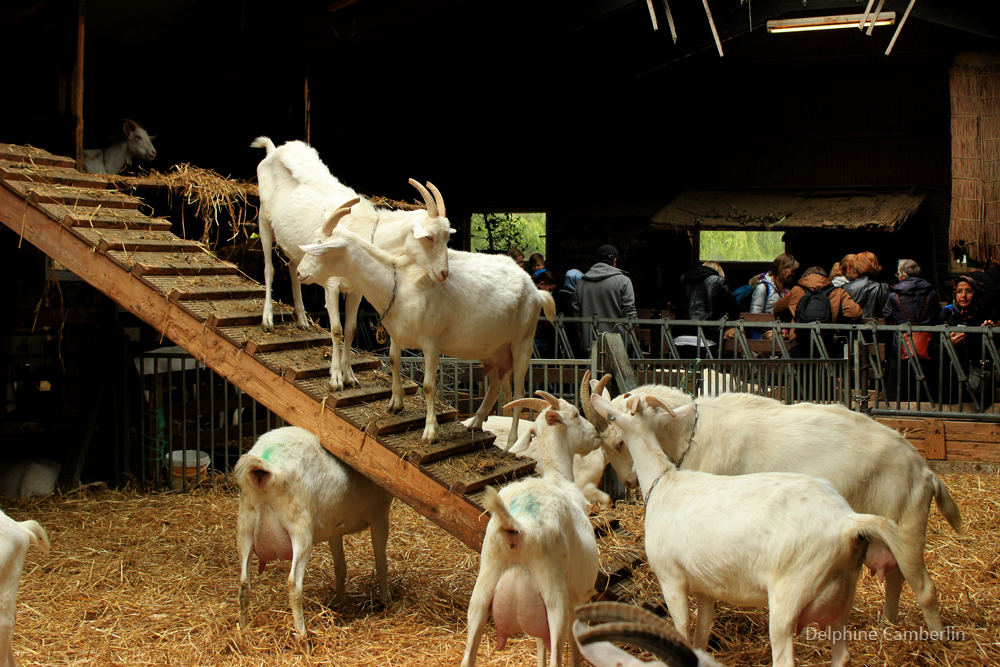
The north of the Netherlands is where the country becomes quieter, flatter, and more authentically Dutch. Groningen is a vibrant university city with a disproportionate amount of culture for its size — excellent museums, a lively café scene, and a beautiful medieval market square. Friesland has its own distinct identity, its own language (West Frisian is officially recognised and spoken by around 400,000 people), and a landscape of extraordinary flatness bisected by canals and dotted with traditional terp mounds — ancient raised settlements built before the dike system existed. The Wadden Sea coast — a UNESCO World Heritage Site — stretches from Den Helder north to the German border, a vast tidal flat of mud, sand, and shallow water that supports millions of migratory birds.
The Wadden Islands — Texel, Vlieland, Terschelling, Ameland, and Schiermonnikoog — are accessible by ferry from the mainland and offer a completely different Netherlands: vast beaches, dune landscapes, cycling trails through nature reserves, and a pace of life that makes Amsterdam feel like another world. Texel, the largest, is famous for its lamb, its lighthouse, and the Ecomare seal sanctuary. These islands are among the finest cycling destinations in the entire country.
The windmill is not a decorative symbol of the Netherlands — it is a functional engineering response to a fundamental problem. Much of the country lies below sea level, and without a continuous system of drainage, the polders would flood within weeks. The windmills were the original pumping mechanism, their rotating sails driving Archimedes screws that lifted water from one level to the next, moving it outward to the sea. Today electric pumping stations do most of the work, but over 1,200 windmills survive, and roughly 600 are still operational.
● Kinderdijk — 19 windmills in two rows along the polder canals, a UNESCO World Heritage Site, easily reached by waterbus from Rotterdam (35 min) or Dordrecht. The most photogenic windmill landscape in the country, especially at dawn. Every Saturday in July and August, all 19 windmills are put in operation simultaneously — a remarkable sight.
● Zaanse Schans — an open-air windmill village 20 minutes north of Amsterdam, where 15 historic windmills were relocated and preserved. Each windmill had a specific industrial function: De Kat grinds paint pigments (the only remaining paint-grinding windmill in the world), De Zoeker produces oil, Het Jonge Schaap is a working sawmill. The complex also includes a cheese farm, clog workshop, and traditional Dutch houses. More curated than Kinderdijk, but fascinating for understanding what windmills actually did.
● Schiedam — home to the tallest windmills in the world, built to feed the Dutch genever (gin) industry. De Noord stands 33.3 metres — higher than a 10-storey building — and was used to grind grain for distilleries. At one point Schiedam had nearly 20 of these giants; five survive today. Far less visited than Kinderdijk or Zaanse Schans, and all the better for it.
● De Schermer polder — 11 windmills in a working polder landscape in North Holland, most still operational, with almost no tourist infrastructure. This is where you find windmills as working countryside rather than heritage attraction. Cycle through on a quiet morning and you will have them almost entirely to yourself.
● National Windmill Day — held every second weekend in May, when hundreds of normally closed windmills across the country open their doors. One of the finest days in the Dutch calendar for visitors — and the best single opportunity to go inside working windmills that are otherwise inaccessible.
Around 26% of the Netherlands lies below sea level, with the lowest point reaching 6.7 metres below the waterline. A further 29% of the country sits at or near sea level and would flood in a severe storm without protection. In total, some 59% of the Netherlands is vulnerable to flooding — including Amsterdam, Rotterdam, The Hague, and Delft. This is not a hypothetical: in February 1953, a North Sea storm surge breached the dikes of Zeeland and the southwestern islands, flooding an area the size of a large city and killing 1,836 people in a single night.
The Dutch response to that disaster was the Delta Works — a programme of dams, sluices, locks, and storm surge barriers built across the Rhine-Meuse-Scheldt delta between 1954 and 1997. The Oosterscheldekering, completed in 1986, is a 9-kilometre moveable barrier with 62 massive steel gates, each the height of a six-storey building. When a severe storm is forecast, the gates close within an hour. It is listed as one of the Seven Wonders of the Modern World — and when you stand on it in person, the scale is genuinely staggering.
The windmills came first. From the 13th century onward, the Dutch understood that the only way to create and maintain agricultural land in a delta was to pump it continuously dry. The polder system — a ring dike enclosing an area, with windmills pumping the interior water out — is one of the great feats of pre-industrial engineering. Flevoland, the most recently created Dutch province, was entirely reclaimed from the sea between 1955 and 1968 using modern electric pumps. It is now home to 400,000 people, on land that 70 years ago was the bottom of the Zuiderzee. The Oostvaardersplassen nature reserve — one of the finest bird-watching sites in Europe — was originally planned as an industrial area on this reclaimed land, but nature moved in before the factories did, and the Dutch had the wisdom to let it stay.
Today the Netherlands exports its water management expertise globally — Dutch engineers and water boards advise on flood protection systems from New Orleans to Jakarta. The country is considered the world leader in climate adaptation, delta management, and sustainable water infrastructure. Visiting the Delta Works, Kinderdijk, or even simply walking through a polder landscape, you are moving through one of humanity's great long-term engineering projects.
Oostvaardersplassen (Nieuw Land National Park) — one of Europe's most important and unusual nature reserves, located in Flevoland between Lelystad and Almere — land that was reclaimed from the sea in 1968 and was supposed to become an industrial zone. Nature colonised it before the factories arrived, and the Dutch authorities had the remarkable good sense to let it be. The result is 56 km² of marshland, reed beds, and wet grassland that now hosts tens of thousands of migratory and resident birds, as well as free-roaming Konik horses, Heck cattle, and red deer. Over 300 bird species have been recorded here, including White-tailed Eagles (their first Dutch comeback), Eurasian Spoonbills, Bearded Tits, Bluethroats, and spectacular gatherings of geese and waders in winter. The visitor centre near Lelystad offers walking routes, wildlife safaris by eco-cart, and telescope viewing areas across the reed beds. It feels nothing like the Netherlands most visitors see, and everything like a genuinely wild place.
De Zoom–Kalmthoutse Heide — a cross-border nature park shared between the Netherlands and Belgium, protecting a rare heathland landscape straddling Noord-Brabant province and the Belgian Antwerp region. The Dutch section (De Zoom) and the Belgian section (Kalmthoutse Heide) together form one of the largest remaining heathland reserves in the Low Countries — purple in August when the heather flowers, and extraordinary for woodland birds year-round, including Black-necked Grebe, Woodlark, and Nightjar. A remarkable place to visit from either side of the border, and almost entirely unknown to international visitors.
The Netherlands has more bicycles than people — approximately 23 million bikes for 17 million inhabitants. The cycling infrastructure is the finest in the world: dedicated cycle lanes on almost every road, cycle-priority junctions, bicycle traffic lights, secure parking at every station, and a culture in which cycling is simply what people do, regardless of age, weather, or distance. Nobody wears lycra. Nobody uses a helmet (though you might want to). People cycle in work clothes, with shopping, with children on the back, in the rain. The Dutch relationship with the bicycle is not sporty — it is civilisational.
The "Cold Shower" for cyclists — this expression, sometimes called the "Dutch headwind experience," is well known among touring cyclists: the Netherlands may be flat, but it is rarely easy to cycle. The prevailing winds come from the south-west off the North Sea, and a headwind on an open Dutch polder road can make flat terrain feel steeper than a mountain pass. Plan your routes with the wind — ride north to south or east to west in the morning (into the wind) and return with it behind you in the afternoon. The best Dutch cycle touring advice: check the wind direction before you plan the day, not just the rain forecast. A tailwind across a flat Dutch polder at 30 km/h with the tulip fields blurring past is one of cycling's greatest pleasures. A headwind across the same road is genuinely demoralising.
The LF Routes (Landelijke Fietsroutes) — the national long-distance cycling network covers approximately 4,500 kilometres, signposted with distinctive green-and-white markers, criss-crossing the entire country:
Accommodation options for cycling tours — the Dutch cycling infrastructure extends to accommodation. B&Bs and small hotels designated fietsvriendelijk (cyclist-friendly) offer secure bike storage, drying rooms, and early breakfasts. Designated cycle-touring campsites allow tent-only pitches (no caravans) and are spaced roughly a day's ride apart along the major routes. For a more comfortable touring option, self-guided cycling holiday companies like Dutch Bike Tours operate luggage-transfer tours where your bags travel ahead to the next hotel while you ride with just a daypack — one of the most stress-free ways to explore the country by bike. Glamping and forest lodge options (see the Veluwe section above) make excellent overnight stops on multi-day routes through central Netherlands.
The node network (knooppunten) — the Dutch cycle junction network uses numbered nodes (knooppunten) at intersections throughout the country. You plan your route by stringing node numbers together, following the signs from one number to the next. It requires no maps, no apps, and no navigation skills — you simply write down a sequence of numbers before you leave and follow the signs. It is so elegantly simple that it has been adopted by Belgium and is now spreading across Europe. Pick up a free node-network map at any tourist office or bike hire shop.
Let's be honest: the Netherlands is not France. Dutch cuisine does not have the international reputation of its southern neighbours, and traditional Dutch cooking is deliberately simple — designed for a cold, practical, maritime culture where food was fuel first and pleasure second. But that is only part of the story. The other part involves 350 years of colonial trade, a vast Indonesian empire, and the most interesting food legacy in Northern Europe. Once you understand that, eating in the Netherlands becomes genuinely exciting.
Traditional Dutch food — what it actually is
Dutch cooking is rooted in the polder and the sea: potatoes, vegetables, smoked fish, dairy, and bread. The flagship dish is stamppot — mashed potato combined with one or more vegetables (kale, sauerkraut, endive, or carrot and onion) and topped with a smoked rookworst sausage. It sounds humble, but done well on a Dutch winter evening it is deeply satisfying. Erwtensoep — split pea soup — is by tradition so thick that a spoon should stand upright in it, and it genuinely often does. These are not dishes that photograph beautifully, but they are honest, filling, and very Dutch.
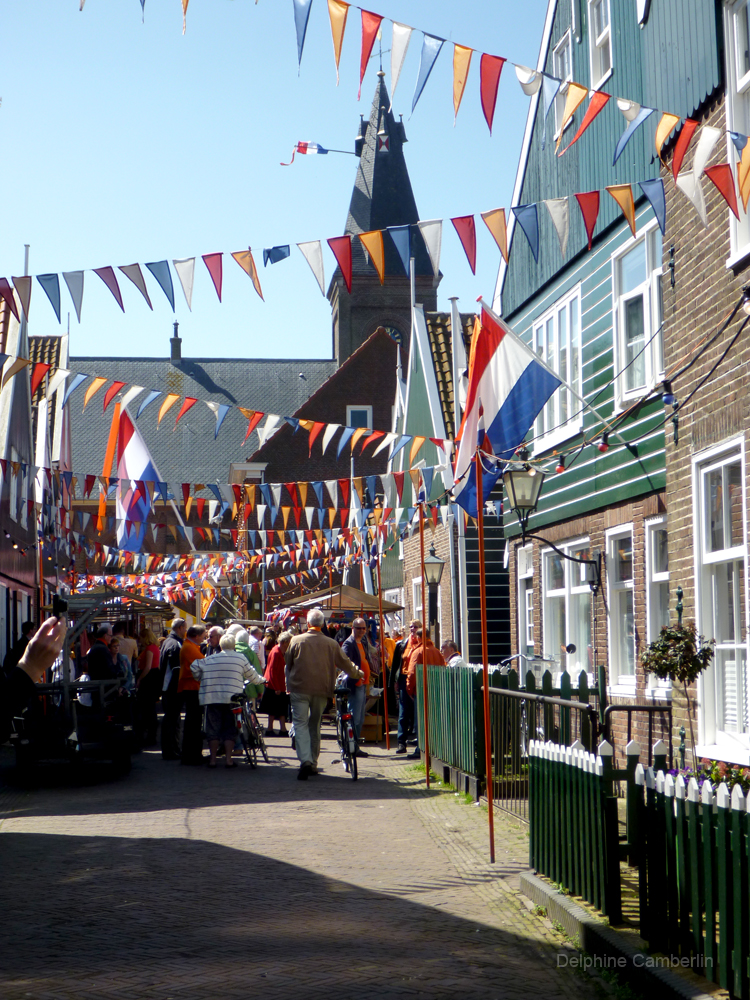
For street food, the Netherlands is excellent. Fresh haring (raw herring), eaten the traditional way — head tilted back, fish held by the tail — from a market stall or haringkar (herring cart) is one of the great Dutch eating rituals. The fish is silky, cold, and mildly briny. Order it met uitjes (with raw onions). Bitterballen — deep-fried crispy balls of meaty ragout, served burning-hot with mustard — are the essential Dutch bar snack, available everywhere and dangerously easy to overeat. A stroopwafel fresh from a market stall is a genuinely exceptional thin waffle sandwich with warm caramel syrup — place it over a hot coffee cup for 30 seconds before eating, as the Dutch do. Poffertjes — tiny, fluffy buckwheat pancakes in a heap with butter and icing sugar — are a market institution.
Dutch cheese deserves its own paragraph. The Netherlands is the world's largest cheese exporter, but the difference between a supermarket Gouda and an aged artisan boerenkaas (farmhouse cheese) bought at a market is profound. Aged Gouda (18+ months) is crystalline, caramel-intense, and complex. The weekly cheese markets in Gouda, Alkmaar, and Edam are genuine spectacles — cheese porters in white uniforms carrying rounds on wooden sledges, the weighing ritual unchanged for centuries. Buy the old cheese, not the young one wrapped in red wax.
Two more things worth knowing: FEBO — the Dutch automat wall of heated snack windows found on city streets — is a uniquely Dutch institution where you feed coins into a slot, lift a small window, and retrieve a hot kroket or frikandel. It is not fine dining. It is perfect at midnight. And drop — Dutch liquorice — is the national confectionery obsession. The Dutch consume more liquorice per capita than any other nation, and Dutch drop is nothing like the sweet version found elsewhere: it ranges from mildly salty to intensely, almost medicinally salty-bitter. Try it once. Many visitors are bewildered. Some become addicted.
The Indonesian legacy — and why the best meal in the Netherlands might be rijsttafel
The most distinctive thing about eating in the Netherlands is the Indonesian connection. The Dutch colonial presence in the Indonesian archipelago lasted from the 17th century until 1949, and the culinary exchange runs deep. Indonesian food is not immigrant restaurant culture here — it is fully woven into mainstream Dutch daily life, eaten by everyone, at all ages, as ordinary weeknight food.
The pinnacle of this is the rijsttafel (literally "rice table") — an elaborate feast of 12 to 20+ small Indonesian dishes served alongside rice. The dishes span the archipelago: beef rendang slow-cooked in coconut and spice, satay with peanut sauce, gado-gado (vegetable salad with peanut dressing), sambal goreng, sweet-sharp acar pickles, prawn crackers, and much more. It is generous, aromatic, and genuinely one of the most pleasurable ways to eat in Europe — and it costs a fraction of what a comparable experience costs in a French or Italian restaurant. For authentic rijsttafel in Amsterdam, Restaurant Blauw (Amstelveenseweg) and Indrapura (near Rembrandtplein) are consistently excellent. In Utrecht, Restaurant Blauw has a second location equally good.
Beyond rijsttafel, nasi goreng (fried rice) and bami goreng (fried noodles) are so embedded in Dutch life that many Dutch people consider them comfort food on a par with stamppot. Surinamese roti shops — another colonial legacy — serve remarkable flatbread with curried chicken and potatoes for a few euros. If you see a Surinamese roti shop, go in.
The honest verdict — Dutch food is not the main reason people visit the Netherlands, but it is better and more interesting than its reputation suggests. The street food is excellent and cheap. The cheese is world-class if you buy the aged kind. The Indonesian food is genuinely outstanding. And the rijsttafel is an experience worth planning an entire evening around.
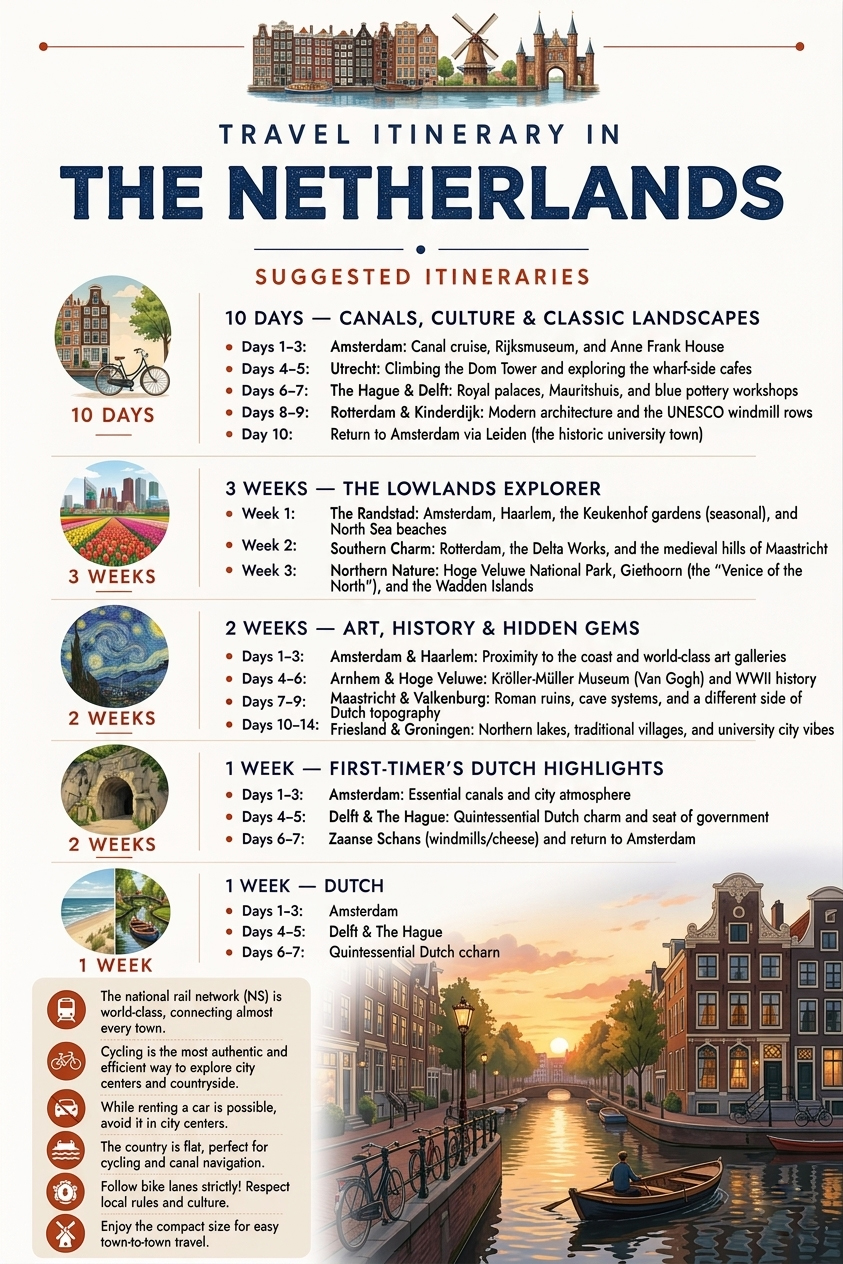
The Netherlands is extraordinarily compact and flat, making it one of the easiest countries to navigate independently. The NS national rail network connects almost every town with trains running every 15–30 minutes. The OV-chipkaart (available at any train station) gives you seamless access to all public transport. For cycling, the knooppunten junction network makes navigation effortless — pick up a free map at any tourist office. Check wind direction before planning your cycling day: a headwind on a Dutch polder road is the one thing that will make flat terrain feel hard.
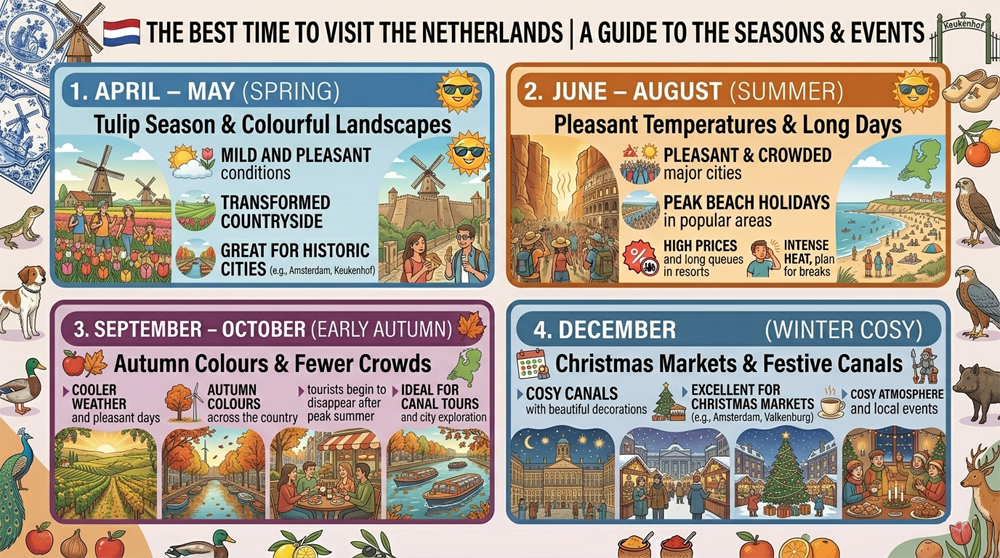
The finest season. Tulip fields in bloom from mid-April, mild temperatures, long days, and the countryside at its most photogenic. Keukenhof gardens are open. Book accommodation early — this is peak season.
Warm and lively, with outdoor terraces, canal boat traffic, and long evenings. The Wadden Islands are at their best. Cycling is excellent. Expect rain regardless — this is the North Sea coast.
Fewer tourists, cooler air, beautiful autumn colours in the Veluwe forest. Eindhoven's Dutch Design Week in October. The canals and cities are more atmospheric with mist and lower light.
Amsterdam's canal houses lit with Christmas lights reflected in dark water is one of Europe's finest winter scenes. Cold and sometimes grey, but the cities are genuinely festive and far less crowded than in summer.
The Netherlands has a temperate maritime climate strongly influenced by the North Sea — mild winters (rarely below freezing), cool summers (rarely above 25°C), and rainfall distributed relatively evenly across all months. Weather changes rapidly and a sunny morning can become a wet afternoon with very little warning. The Dutch response to this is not to stay inside but to dress appropriately and go out anyway — and their cycling culture proves that the weather is not actually an obstacle to a good life outdoors.
The single most important weather factor for cyclists and outdoor visitors is not rain but wind. The Netherlands is extremely exposed to Atlantic winds, and a south-westerly headwind on a flat polder road can make cycling genuinely hard. Check the wind forecast and plan routes accordingly.
Spring — March to May
Mild and increasingly sunny. Best tulip season mid-April. Ocean winds still strong.
Spring & Summer
Slightly warmer and drier than the coast. The Veluwe forests are superb from May through October.
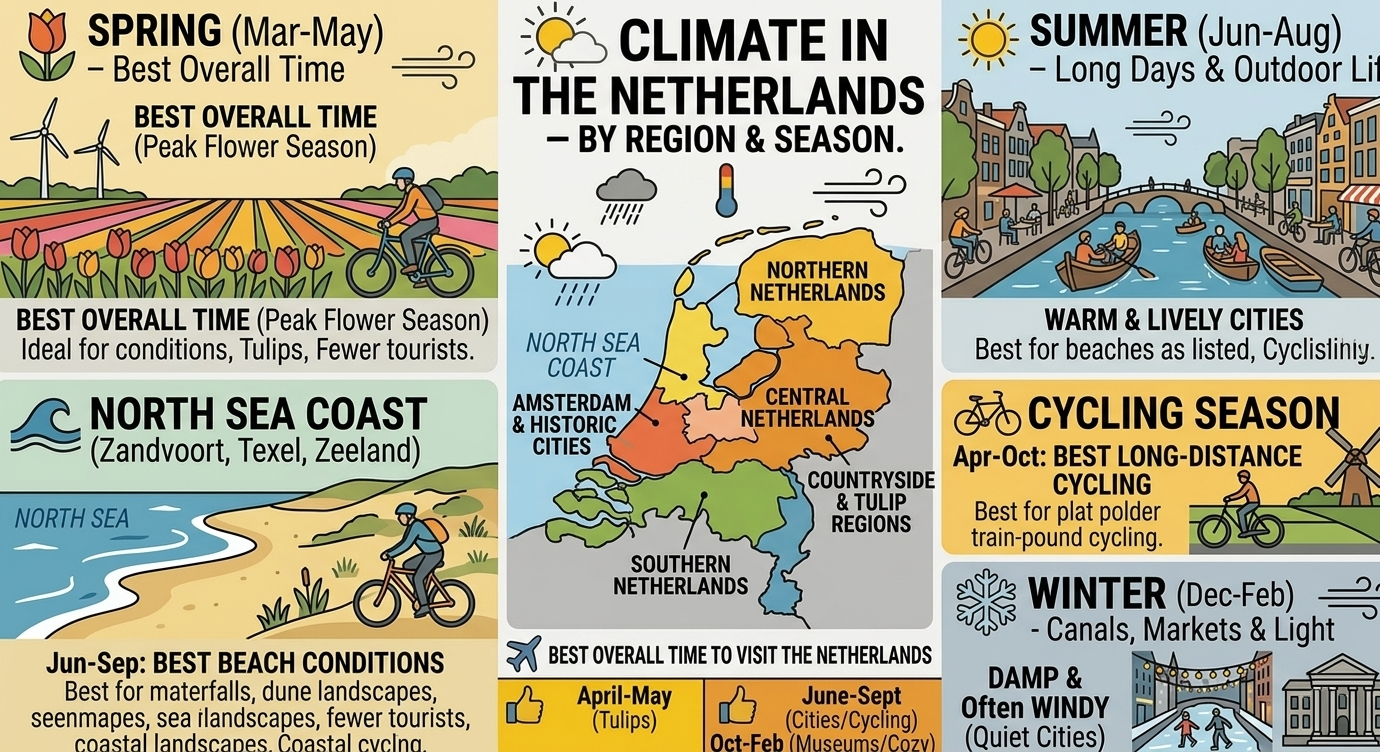
Summer — June to September
Best conditions for the Wadden Islands — beaches, cycling, birdwatching.
April to October
The reliable cycling window. April–May for tulip fields, June–August for coast and islands, September–October for the Veluwe forest. Always bring a packable waterproof regardless of the forecast.
Skip the SIM hunt on arrival. A travel eSIM lets you activate local data before you board — no plastic card, no roaming fees, instant setup. Roamic covers this destination and most countries in the Galerie.
Get Your Travel eSIM →🎟️ GetYourGuide: "Experiences I'd book: a Keukenhof day trip in April, a Kinderdijk windmill tour by waterbus from Rotterdam, an Amsterdam canal evening cruise, a Delta Works guided tour, and a Hoge Veluwe National Park cycling day."
Stock Photography
Browse and license the full Nature photography collection — available for commercial and editorial use on Shutterstock.
View on Shutterstock →
Stock Photography
Browse and license the full Permaculture photography collection — available for commercial and editorial use on Shutterstock.
View on Shutterstock →