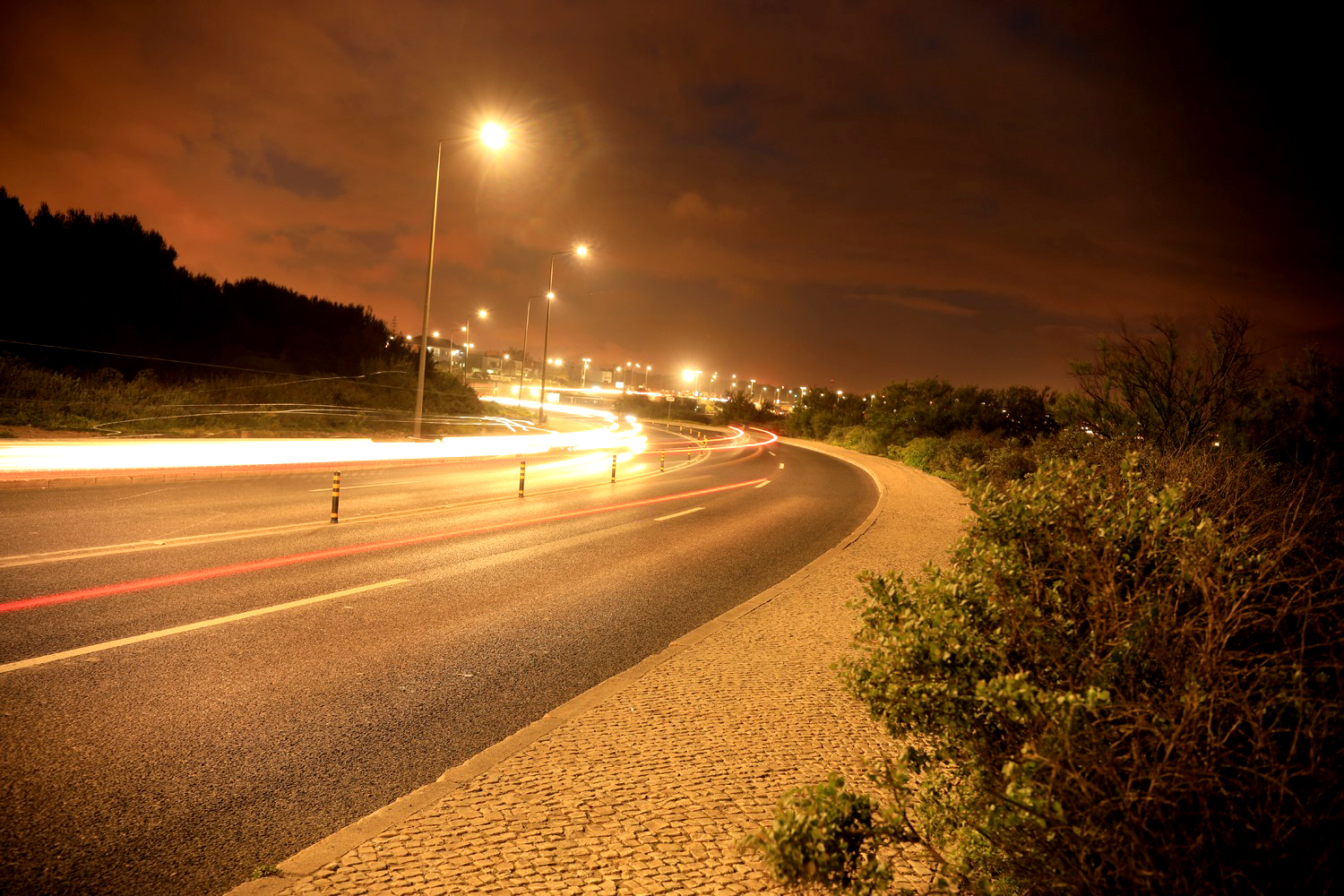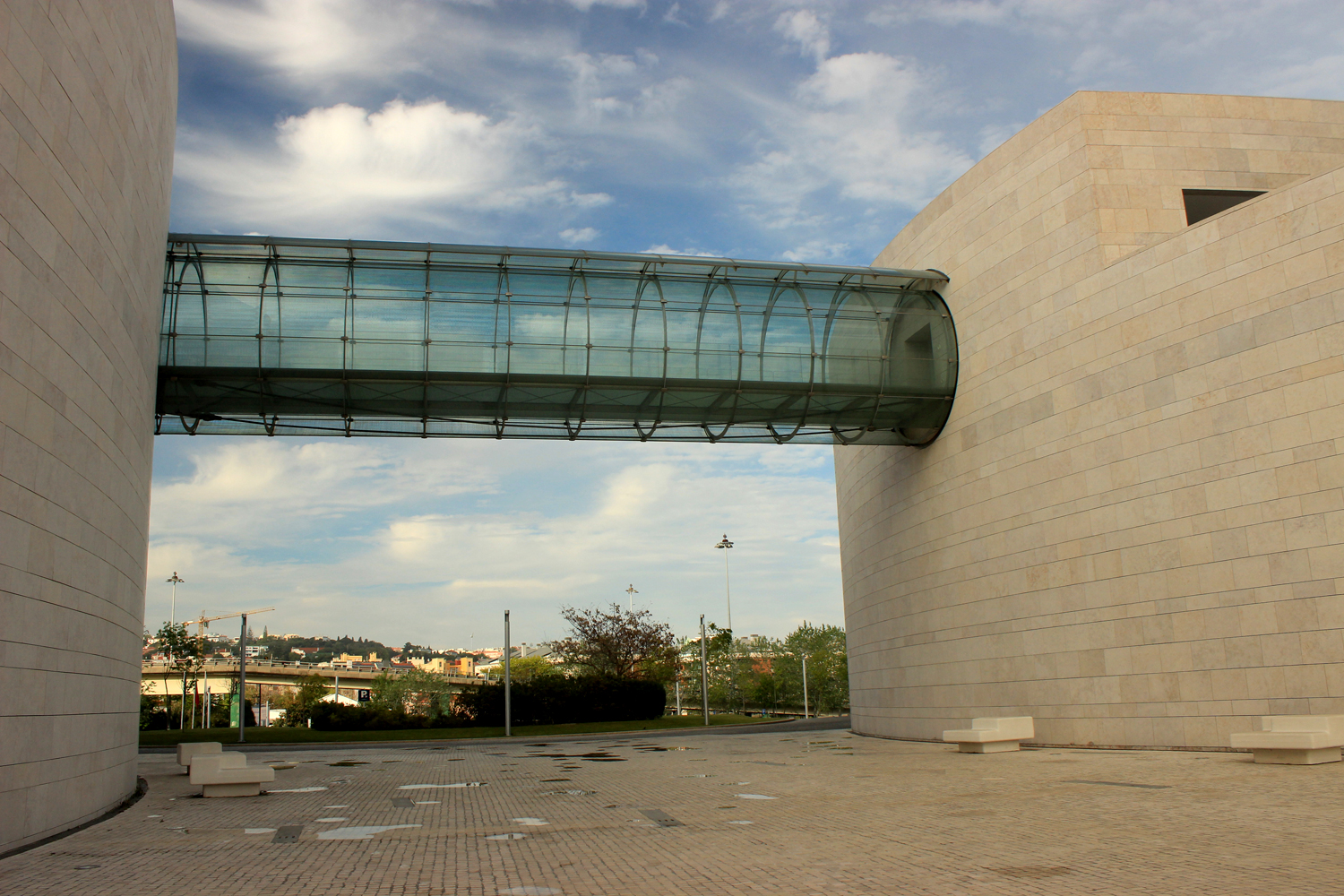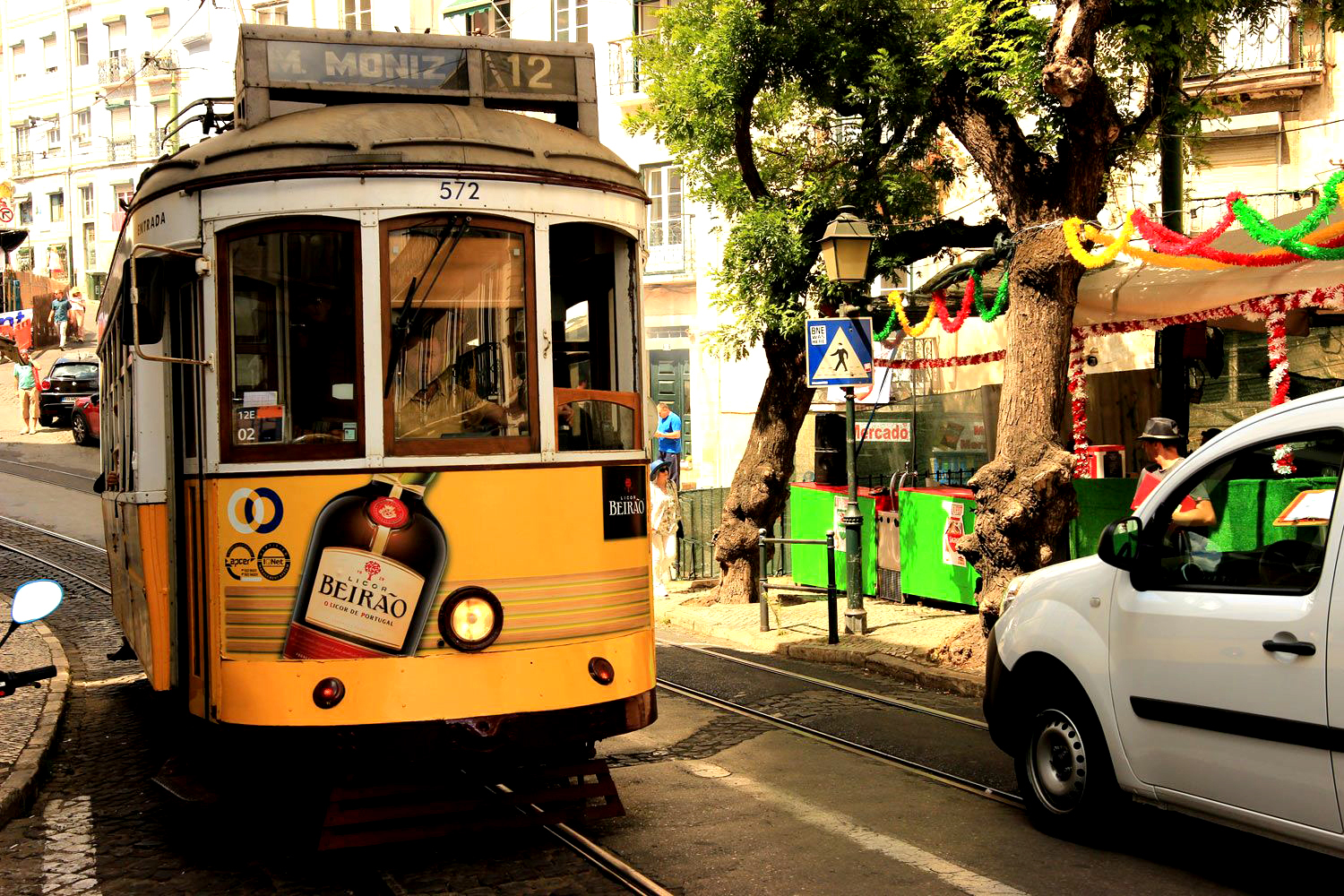
Portugal is where Europe goes when it wants to remember what travel used to feel like before everywhere got the same. Lisbon's Alfama neighbourhood — its yellow trams grinding up cobbled hills, fado drifting from upstairs windows, azulejo tiles catching the afternoon light — is one of the most photogenic urban environments in Europe. Porto's granite facades and wine-barge reflections on the Douro at dusk are equally compelling. And beyond the cities, the Alentejo's cork forest silence, the Algarve's ochre cliffs at golden hour, and the volcanic drama of the Azores add landscape dimensions that most visitors never reach. Portugal rewards those who go further.
Lisbon is one of Europe's most captivating capitals — a city of seven hills, extraordinary light, and the particular melancholy the Portuguese call saudade. Trams grind up cobbled streets so steep that neighbouring houses block the sky; azulejo tiles catch the afternoon light on every second facade; and the Tagus river — the widest in Iberia, more like an inland sea at Lisbon than a river — opens the city southward to the Atlantic. Lisbon has been the capital of a global empire (Portuguese navigators reached Brazil, India, Japan, and the coast of Africa in a single century of oceanic ambition from 1450 to 1550) and has also known catastrophic collapse: the earthquake and tsunami of 1755 destroyed most of the medieval city in six minutes. The Pombaline grid of the Baixa district — the elegant 18th-century reconstruction, earthquake-proofed with a wooden cage structure beneath the stone facades — is the visible legacy of that rebuilding.
Alfama and Mouraria — the two oldest neighbourhoods in Lisbon, the only ones that survived 1755 largely intact, built on the hillside below the Castelo de São Jorge. Alfama is a labyrinth of alleys too steep and narrow for cars, draped in laundry, decorated with hand-painted tiles, and punctuated by miradouros (hilltop viewpoints) where locals sit with a Sagres beer watching the light change over the Tagus. It is one of the finest urban walking environments in Europe. Mouraria, immediately below, was historically the Moorish quarter of Lisbon and remains more multicultural — the food stalls around the Intendente square serve Mozambican, Bangladeshi, and Indian food alongside traditional petiscos. Both neighbourhoods are best explored without a destination in mind.
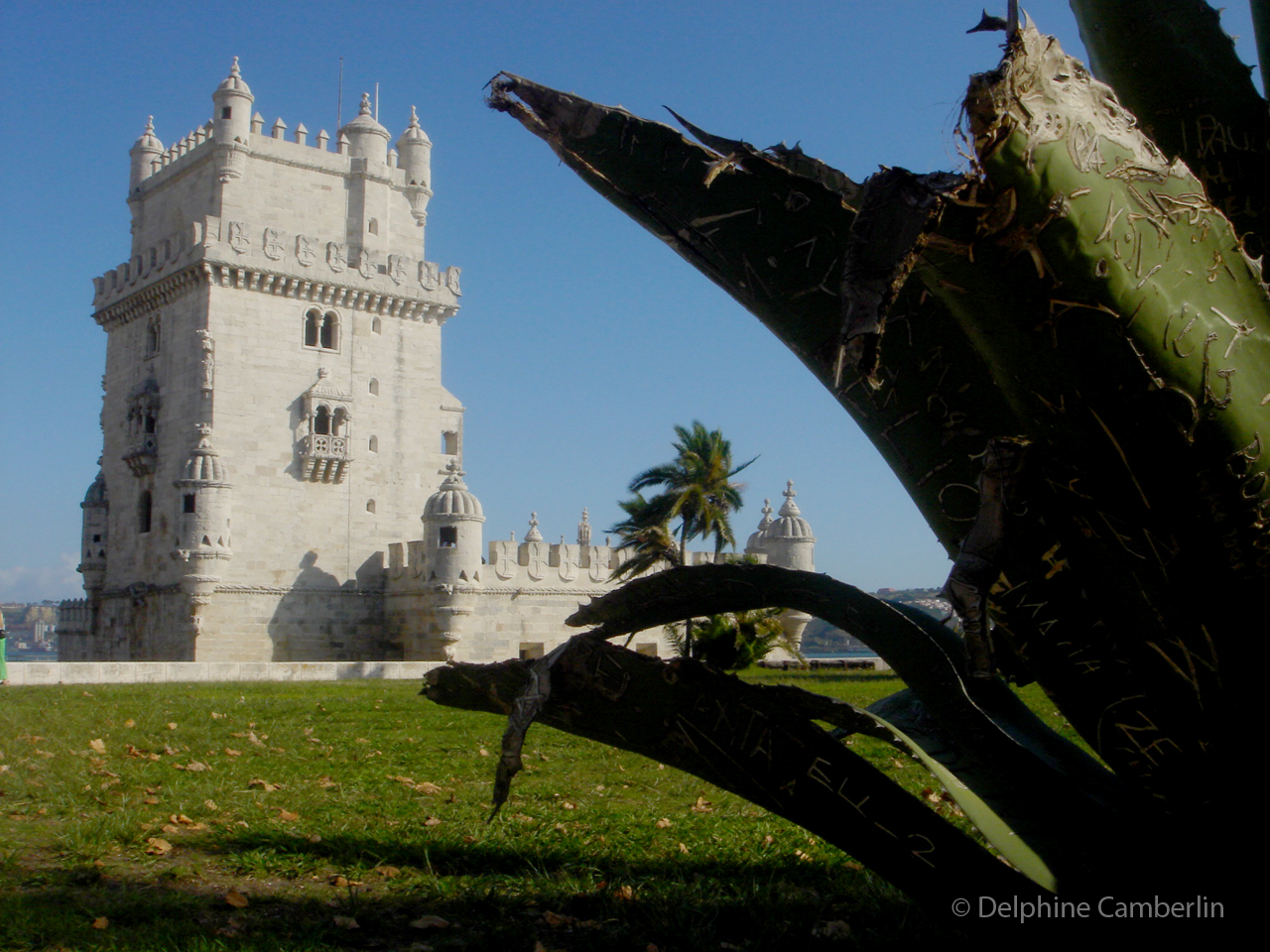
Belém — the western suburb from which Vasco da Gama departed for India in 1497, and where the Manueline architecture of the Age of Discovery reaches its most elaborate expression. The Torre de Belém (a Manueline watchtower on the Tagus, decorated with nautical motifs — rope-knot stonework, armillary spheres, Portuguese shields) and the Jerónimos Monastery (one of the finest Gothic-Manueline buildings in the world, built from the profits of the spice trade) together justify the 15-minute tram ride from central Lisbon. Pastéis de Belém — the original custard tart bakery, operating since 1837, recipe unchanged and kept secret — is two minutes from the monastery. The queue moves faster than it looks.
Sintra and Cascais day trips — the Serra de Sintra, 30 minutes by train from Rossio station, is a UNESCO-listed landscape of forest, palaces, and extraordinary romantic-era follies: Pena Palace (a confection of turrets, domes, and battlements in competing colours perched on a rocky summit above the clouds — it looks like a painting's idea of a castle), Quinta da Regaleira (a Gothic-Masonic estate with initiatic wells descending underground through spiralling stone staircases), and the ruined Moorish castle walls commanding views from the Serra's spine. Cascais, also 30 minutes by train but westward along the coast, is a handsome fishing-town-turned-resort with the finest municipal art museum in the Lisbon region and the dramatic Boca do Inferno (Mouth of Hell) sea cave a short walk from the marina.
Portugal is one of Europe's most accessible and affordable destinations for photographers. Direct flights from most European cities are under two hours to Lisbon or Porto, accommodation is significantly cheaper than comparable Western European capitals, and the country's geography — from Atlantic coast to mountain interior to island archipelago — means an enormous variety of photographic environments within a single trip. The light quality here, particularly in the south and on the Azores, is exceptional year-round.
| 🗓️ | Recommended stay | 7 – 14 days |
| 🎒 | Budget / day | €45–70 / $50–77Hostel, local tasca lunches, CP trains |
| 🥂 | Luxury / day | €150–300 / $165–330Boutique hotel, wine tastings, taxis |
| 📅 | Best months | March – June · September – October |
| 🌡️ | Climate | 10–30°C · Warm dry summers · Mild wintersAlgarve is among Europe's sunniest regions · Rarely below 5°C in Lisbon |
| ✈️ | Visa | Schengen — EU / EEA free · US / UK visa-free 90 days |
| 💵 | Currency | EUR · Cards almost everywhere · Rural Alentejo & small villages: carry some cash |
| 🚂 | Getting around | CP trains good for main cities · Rental car essential for Alentejo, Douro Valley & Minho |
| 🛡️ | Safety | Low — one of Europe's safest countriesWatch pockets in Lisbon Alfama & on trams |
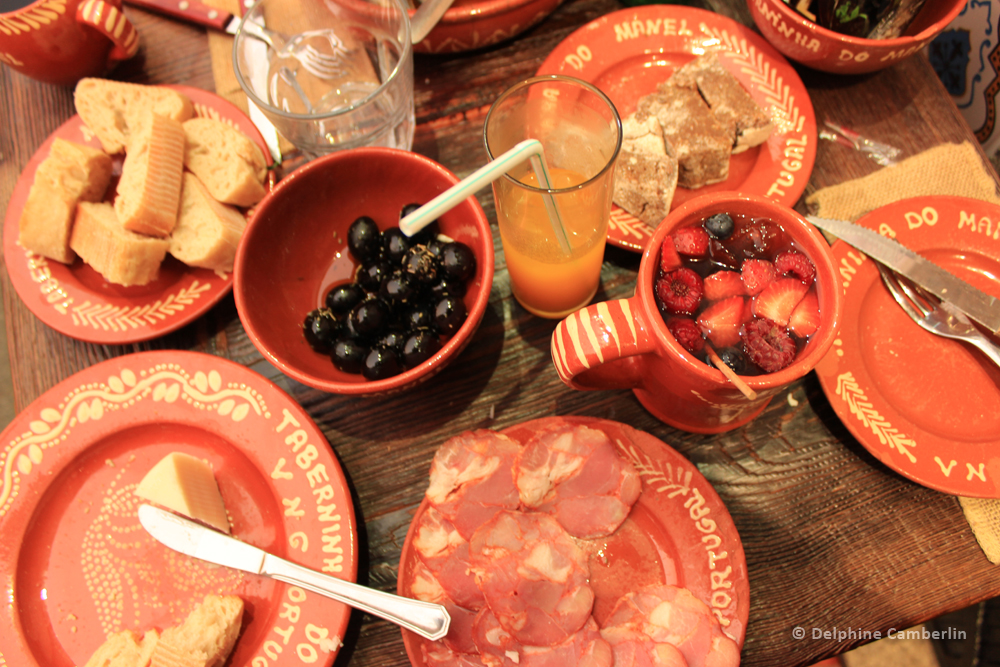
| 🍜 | Must-try food | Pastel de nata, bacalhau (salt cod — 365 recipes!), francesinha, grilled sardines, Vinho Verde |
| 💬 | Language | English well spoken in Lisbon & Porto · Less so in rural areas · Any attempt at Portuguese is warmly received |
The Alentejo is Portugal's soul — a vast, unhurried region covering a third of the country's total area, east of Lisbon and north of the Algarve. Where the coast is energetic and the cities are dense with history and visitors, the Alentejo is the opposite: a landscape of long horizons, cork oak forests (Portugal produces more than half the world's cork, and the Alentejo holds the greatest concentration of cork oaks on Earth — the bark is stripped every nine years in a process that neither harms nor kills the tree), golden wheat plains in summer, and white-washed hilltop villages that appear, from a distance, to grow directly from the rock they're built on.
Évora — the Alentejo's finest city, and one of the best-preserved medieval towns in Portugal. The Roman Temple of Évora (2nd century CE, 14 Corinthian columns still standing in the middle of the old town, illuminated at night) is one of the finest Roman monuments in the Iberian Peninsula. The Gothic cathedral and the 16th-century University of Évora ring the historic centre, and the entire walled city is UNESCO-listed. The megalithic landscape surrounding Évora — stone circles (Cromeleque dos Almendres, one of the largest prehistoric stone circles in Europe, predating Stonehenge), standing stones, and dolmens scattered across the cork oak countryside within 20km of the city — is one of Portugal's least-visited and most quietly extraordinary destinations.
Alentejo food and wine — the region produces some of Portugal's finest wines (the deep, tannic reds from the Alentejo DOC — Herdade do Esporão, Herdade Grande, Monte da Peceguina — are now recognised internationally) and its own distinct cuisine: slow-braised pork with clams (carne de porco à alentejana — the combination of pork and shellfish is a hallmark of the region, the clams opening in the same pan as the marinated cubed pork), bread-based soups (açorda alentejana — bread, garlic, coriander, olive oil, and a poached egg), and the extraordinary olive oils that the long hot summers and chalky soils produce. Staying in a herdade (traditional Alentejo farmhouse estate) and eating from the estate's own production is the finest way to understand what slow food means at its source.
The Algarve is Portugal's sun-drenched southern coast — 150km of Atlantic coastline between the Spanish border and Cabo de São Vicente, Europe's most south-westerly point and historically the last land Portuguese navigators saw before the open ocean. The eastern Algarve (Tavira, Ria Formosa) is flat, lagoon-laced, and quiet; the central Algarve (Albufeira, Portimão) is the developed resort coast; and the western Algarve (Lagos, Sagres, the Costa Vicentina) is where the landscape becomes dramatic: ochre and terracotta limestone cliffs carved into arches, sea stacks, and sea caves of extraordinary geometry, with some of Europe's finest surf beaches at their feet.
Lagos and the western cliffs — the most photogenic stretch of the Algarve coast runs from Lagos westward to Sagres. The Ponta da Piedade (three sea stacks and a forest of needles rising from turquoise water, accessible by boat from Lagos or by a 2km clifftop walk) is the finest coastal landscape in southern Portugal. The Praia de Marinha, the Benagil sea cave (accessible by kayak or boat from Benagil beach — the cave's domed ceiling has a circular opening to the sky and a beach inside), and the Praia da Dona Ana at Lagos are the standout beaches of the central-western coast.
Sagres and Cabo de São Vicente — Sagres sits at the extreme southwest corner of Europe, where the Atlantic storms roll in unimpeded from the open ocean and the landscapes feel genuinely exposed and wild. The Fortaleza de Sagres (a fortress on a headland above the Atlantic, associated with Henry the Navigator's legendary school of navigation) and Cabo de São Vicente — the most south-westerly point of continental Europe, a lighthouse on a cliff above 75-metre sea walls — are places with a specific weight and loneliness that feels different from the rest of the Algarve. The surf at Arrifana, Carrapateira, and Bordeira on the Costa Vicentina north of Sagres is world-class.
Ria Formosa and Tavira — the eastern Algarve has a completely different character: the Ria Formosa Natural Park is a 60km lagoon system of barrier islands, tidal channels, and salt marshes — one of the most important bird habitats in Western Europe and home to the greater flamingo colonies that winter here. Tavira, the finest town in the eastern Algarve, is a well-preserved Roman-and-Moorish historic centre with more churches per square kilometre than anywhere else in Portugal outside Lisbon and Porto. The ferry to Ilha de Tavira (a barrier island with an undeveloped Atlantic beach) runs year-round.
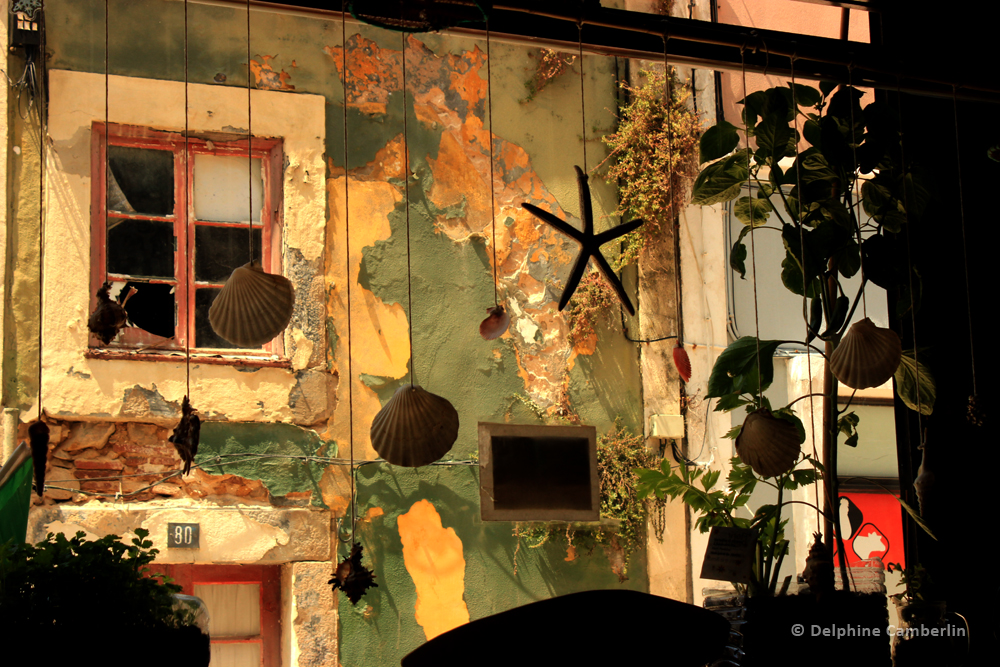
● Lisbon's Alfama and Mouraria — the best light in Lisbon hits the tiled facades in late afternoon on the south-facing streets above the Tagus. The miradouros (viewpoints) at Portas do Sol and Santa Luzia give you city-scape compositions from above, while the lanes below offer the close textures of azulejo and peeling plaster that make Lisbon so distinctive.
● The Algarve cliffs — the sea stacks and arches around Lagos and Praia da Marinha are at their most dramatic at sunrise, when the low light rakes across the ochre limestone and turns the sea below a deep turquoise. The clifftop path west of Lagos offers viewpoint after viewpoint in under an hour's walk.
● The Azores — São Jorge island — the fajãs (flat coastal ledges created by lava flows) of São Jorge offer some of the most otherworldly coastal photography in Europe. The walk down from the island's spine to the fajã below, with the Atlantic stretched out to the horizon, is one of the finest coastal walks I've done.
● Peneda-Gerês and the Northern Villages — the ancient granite villages of Soajo and Lindoso, with their espigueiros (raised grain stores) standing in rows on stone platforms, are entirely unique to this corner of Portugal. The combination of granite, moss, and mountain landscape photographs beautifully in overcast light.
🎟️ GetYourGuide: "A few experiences I'd book again without hesitation: a private fado evening in Alfama, a Douro Valley wine cruise, and a full-day Sintra and Cascais tour."
The Azores are nine volcanic islands rising from the mid-Atlantic, 1,500km west of Lisbon — technically Europe, geologically Africa and North America meeting, atmospherically something entirely their own. Created by volcanic hotspot activity that continues today (the most recent eruption was on Faial in 1957; the island of Pico is a near-perfect volcanic cone of 2,351m — the highest peak in Portugal — that rises directly from the sea), the Azores offer a landscape that has no equivalent elsewhere in European territory: calderas filled with twin lakes in different colours, hydrangea hedgerows lining every road in summer, geysers and hot springs emerging from the earth, endemic species found nowhere else, and an almost continuous procession of weather systems rolling in from the open Atlantic.
São Miguel — the largest island and the entry point for most visitors. The Sete Cidades caldera (two lakes — one green, one blue — separated by a bridge in a volcanic crater 5km across, seen from the Vista do Rei viewpoint above) is the defining Azorean image. Lagoa do Fogo ("Lake of Fire") is higher, wilder, and surrounded by mist even on clear days. The Furnas valley contains a working geothermal landscape: boiling mud pools, geysers, and the Caldeiras das Furnas — the thermal pools where, since the 16th century, Azoreans have buried clay pots of cozido das Furnas (a slow-cooked stew of beef, pork, chicken, sausage, and vegetables) in the hot earth to cook over 6–8 hours. Eating cozido at a Furnas restaurant — knowing the pot was cooking in the volcanic ground outside while you drove in — is one of the finest food experiences in Portugal.
The other islands — each is distinct enough to justify its own visit. Flores (the westernmost island, the furthest west in the entire EU) for waterfalls and the most dramatically sculpted coastline; Faial for the preserved volcanic landscape of the 1957 Capelinhos eruption (a lighthouse buried to its neck in ash and lava, now a landmark of geological time); Pico for the wine culture (the Pico wine landscape — small stone-walled enclosures of vines against the volcanic black soil, producing a white wine of unique mineral character from the Verdelho grape — is UNESCO-listed) and the whale watching (the Azores sits within the migration routes of 24 whale species; sperm whales are resident year-round); São Jorge for the fajãs — the flat coastal ledges of solidified lava where the island's renowned aged cheese is produced; Terceira for the historic UNESCO-listed city of Angra do Heroísmo.
Porto is Portugal's second city and, for many visitors, its first love. Where Lisbon is warm, outward-looking, and imperial in its self-image, Porto is granite, mist, and introversion — a northern city of medieval alleys descending to a river gorge, wine cellars on the opposite bank, and a fierce local pride. The Ribeira waterfront — UNESCO-listed, barcos rabelos moored on the river below the iron Dom Luís I bridge — is the defining image. Beyond it: São Bento Station (entrance hall tiled with 20,000 azulejos depicting Portuguese history, installed 1905), the independent restaurants of Cedofeita, and the clifftop Crystal Palace gardens.
Port wine and the Douro Valley — Port is made in the Douro Valley (steep schist terraces 100km east) and aged in the Vila Nova de Gaia lodges directly across the river. Graham's, Taylor's, Sandeman, and Ramos Pinto all offer cellar tours through barrel warehouses of tremendous atmosphere. The Douro valley itself — UNESCO-listed terraced vineyards on near-vertical slopes catching morning fog and afternoon gold — is the essential companion. Drive the N222 (voted the world's most scenic road) or take the Linha do Douro scenic train from Porto Campanã to Pinhão (3 hours, the finest rail journey in Portugal). The September/October vindima (harvest, still done by hand on steep terraces) is the finest time to visit.
Peneda-Gerês and the Northern Aldeias — Portugal's only national park sits on the Spanish border in the extreme northwest: granite massifs, clear rivers, ancient Roman roads, and the espigueiros — elevated stone granaries on legs standing in rows in the villages of Soajo and Lindoso, unique to this corner of Iberia and extraordinarily photogenic. The Aldeias Históricas further south include Monsanto (built among and atop enormous granite boulders — the most architecturally extraordinary village in Portugal) and Piódão (a slate village in a mountain valley of startling beauty).
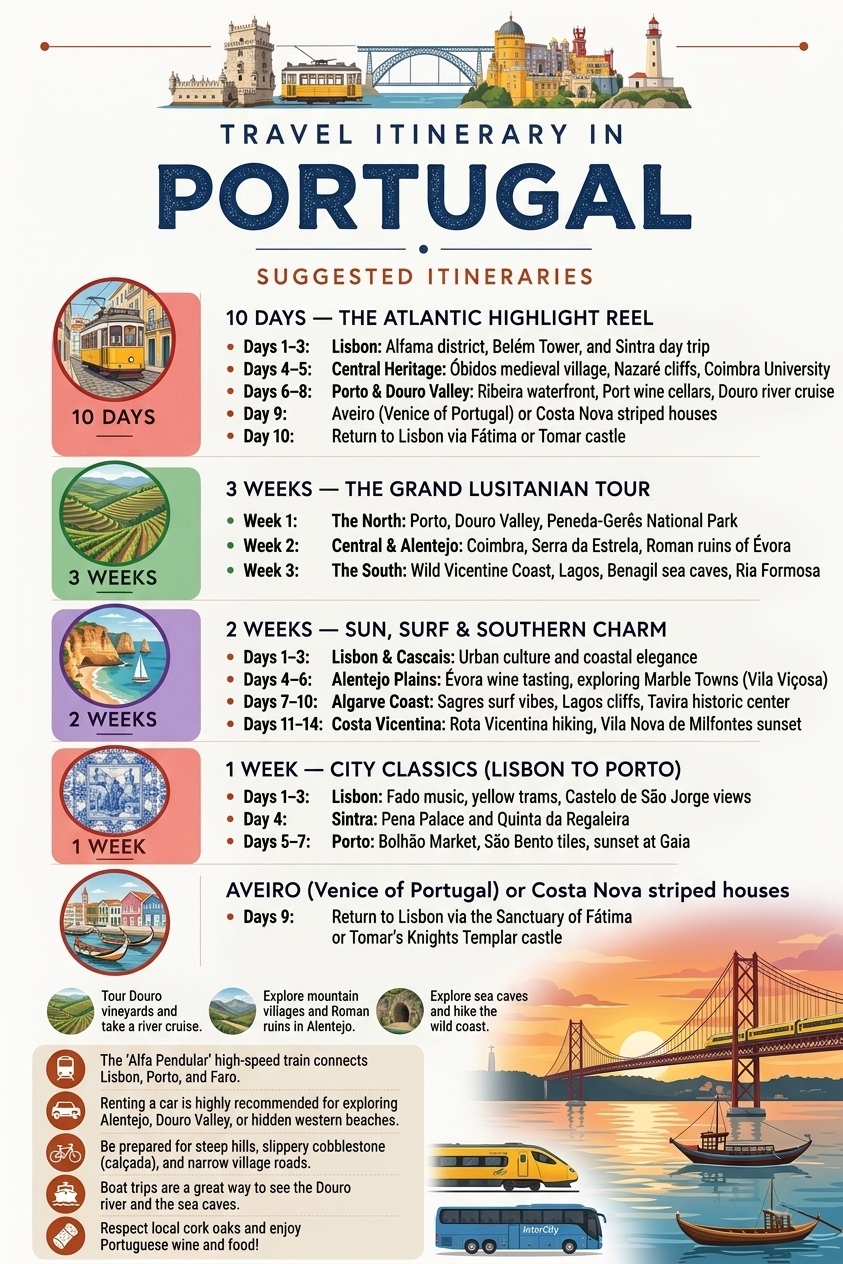
Portugal is a relatively narrow country, making it easy to traverse from North to South. The "Alfa Pendular" high-speed train is excellent for connecting Lisbon, Porto, and Faro. However, renting a car is highly recommended for exploring the Alentejo region, the Douro Valley, or the hidden beaches of the western coast where public transport is less frequent. Be prepared for steep hills, beautiful but slippery cobblestone (calçada), and narrow village roads!
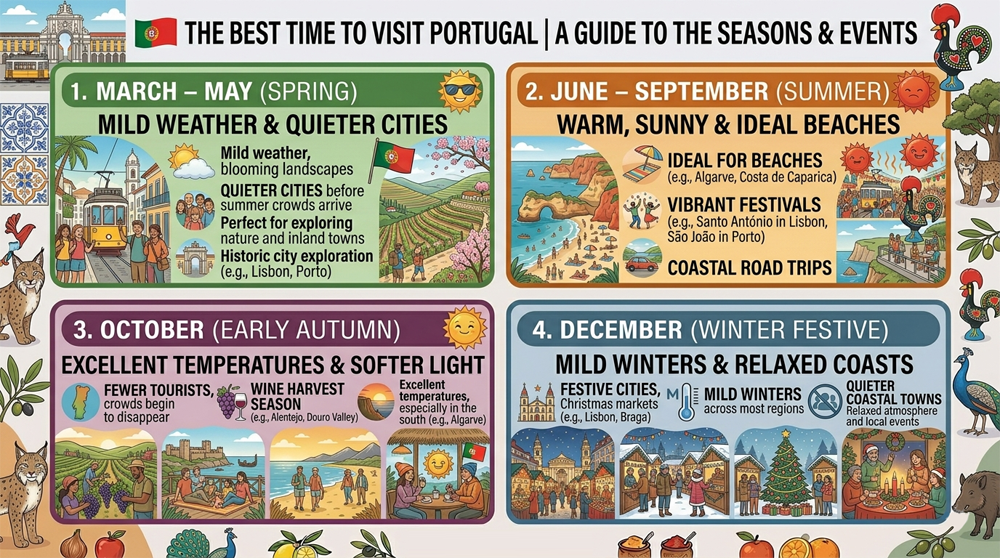
Spring offers mild weather, blooming landscapes, and quieter cities before summer crowds arrive.
Warm, sunny months ideal for beaches, festivals, and coastal road trips.
Ecellent temperatures remain, especially in the south, with fewer tourists and softer light.
Festive cities, mild winters, and quieter coastal towns create a relaxed atmosphere.
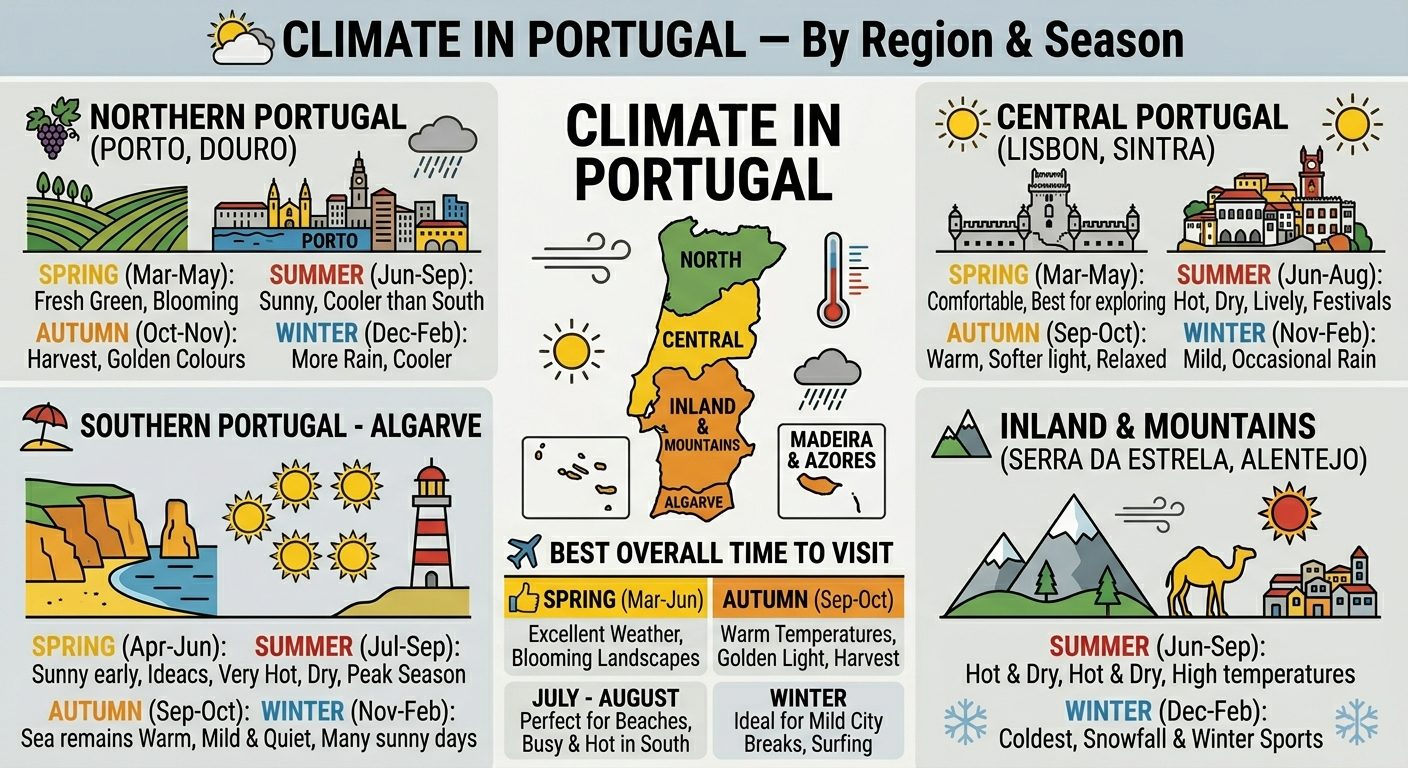
Portugal enjoys one of Europe’s mildest and sunniest climates, but the weather varies significantly between the cooler, greener north and the warmer southern regions. The Atlantic Ocean strongly influences the country, bringing mild winters, warm summers, and changing coastal conditions throughout the year. From the vineyards of the Douro Valley to the beaches of the Algarve and the mountains of Gerês, each region offers a different atmosphere depending on the season.
Spring — March to May Fresh green landscapes, blooming vineyards, and mild temperatures make spring one of the most beautiful seasons in the north.
Spring — March to May Comfortable temperatures and fewer crowds make this one of the best periods for exploring cities and coastal towns.
Spring — April to June Sunny weather arrives early in the Algarve, making it ideal for beaches, hiking trails, and coastal road trips before summer crowds.
(Serra da Estrela, Alentejo Interior)
🎟️ GetYourGuide: "A few experiences I'd book again without hesitation: a private fado evening in Alfama, a Douro Valley wine cruise, and a full-day Sintra and Cascais tour."
Stock Photography
Browse and license the full Portugal photography collection — available for commercial and editorial use on Shutterstock.
View on Shutterstock →
Stock Photography
Browse and license the full Spain photography collection — available for commercial and editorial use on Shutterstock.
View on Shutterstock →