Search across 18 country guides, eco articles, photography, and travel resources.

ALL DESTINATIONS Balkans — Old Europe before the crowds — Ottoman, Byzantine, Adriatic
EUROPE

BalkansSarajevo, Mostar, Ohrid, Skopje, Albanian Riviera

Why Visit the Balkans, in South East Europe?

The Balkans are Europe's most underrated travel region — a patchwork of cultures, landscapes, and histories that most tourists fly straight over on their way somewhere else. From the UNESCO-listed Ottoman streets of Berat in Albania to the Byzantine churches of Ohrid in North Macedonia, the medieval walls of Dubrovnik in Croatia to the rose valleys of Bulgaria, this is a corner of Europe that rewards curiosity with extraordinary visual material and almost no crowds. The Balkans are what Western Europe looked like before mass tourism arrived.

③ Photography Highlights

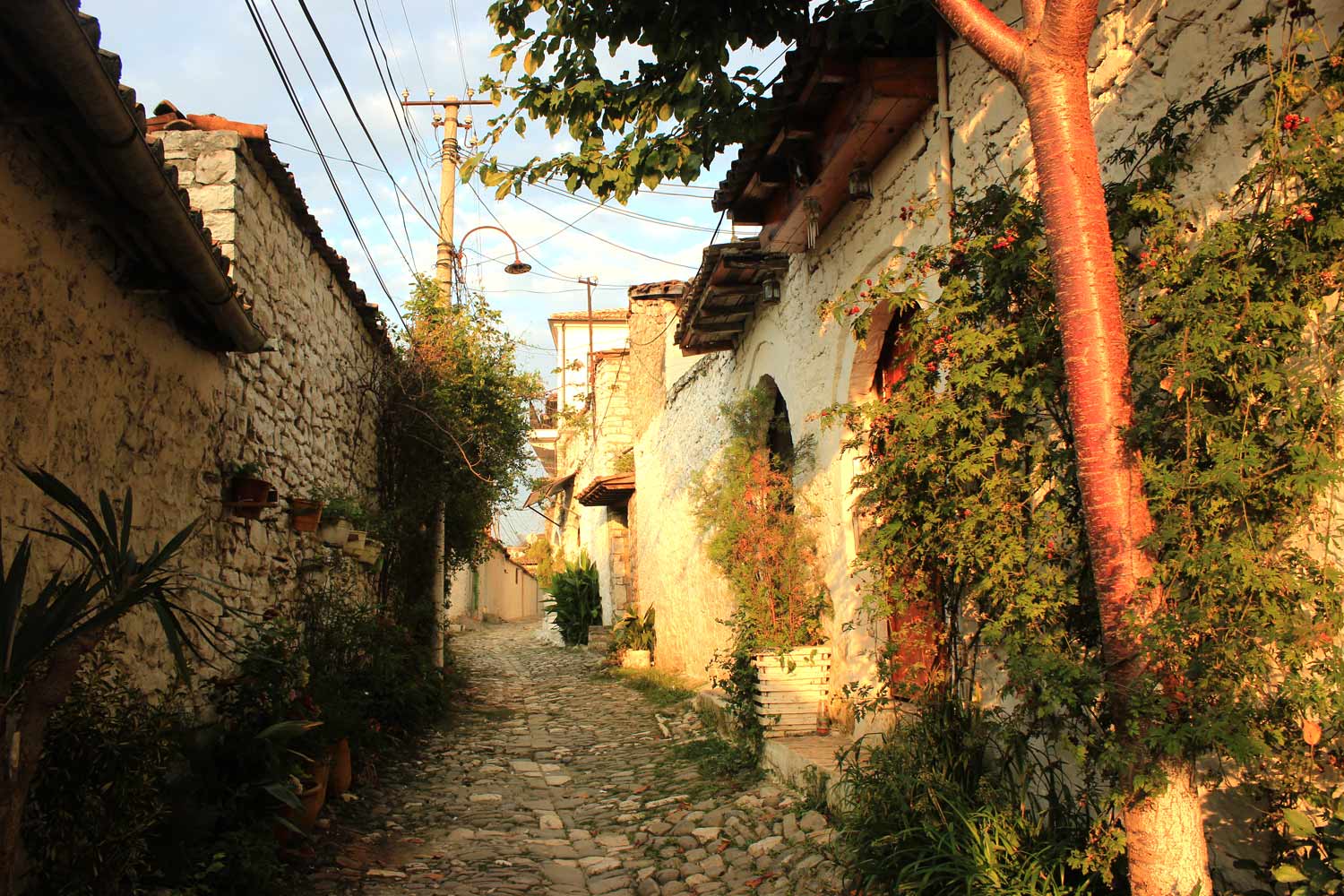
Berat, Albania is the single most photogenic town I found in the Balkans — a UNESCO World Heritage city of a thousand windows, where Ottoman houses stack up the hillside in perfect symmetry. Shoot from the castle at golden hour and you'll have one of those images that stops people scrolling.

Kotor Bay, Montenegro offers dramatic mountain-meets-sea scenery that few people associate with the Balkans. The old town walls rising above the bay make for a classic wide-angle shot, and the kayaking perspective from water level is something else entirely.

Ohrid, North Macedonia — the old church of St John at Kaneo sitting on a promontory above the lake is one of the most-photographed spots in the region, and deservedly so. Come in the early morning mist for the best light.

Sofia and Plovdiv, Bulgaria — Plovdiv's old town is a hidden gem of colourful National Revival architecture, and Sofia's Alexander Nevsky Cathedral provides one of the most striking Orthodox subjects in Eastern Europe.

Travel Information about The Balkans countries

The Balkans offer some of the best value travel in Europe — your daily budget stretches significantly further than in Western Europe, and the region's improving transport infrastructure makes multi-country itineraries genuinely feasible. Budget travellers can travel well here; the challenge is navigating border crossings and varying currencies efficiently.

🗓️Recommended stay14 – 21 days
🎒Budget / day€30–50 / $33–55Guesthouse, local food, buses
🥂Luxury / day€100–180 / $110–200Boutique hotel, restaurants, private transfers
📅Best monthsMay – September
🌡️Climate18–30°C · Hot dry summers, mild springsMountains can be cool — bring a layer
✈️VisaVisa-free for EU / US / UK in most countries (Serbia, Albania, N. Macedonia, Bulgaria)
💵CurrencyEUR in Montenegro & Kosovo · Local currencies elsewhere · Cash essential in rural areas
🚌Getting aroundBuses between countries · Taxis and walking in cities · Trains unreliable
🛡️SafetyMedium — generally safePickpocketing in busy tourist areas
🍜Must-try foodĆevapi, burek, baklava, ajvar, rakija
💬LanguageEnglish limited outside capitals · Basic local phrases appreciated · Cyrillic script in Serbia & Bulgaria
Region 01

Croatia & Bosnia-Herzegovina — Coastline, Bridges & Ottoman Cities

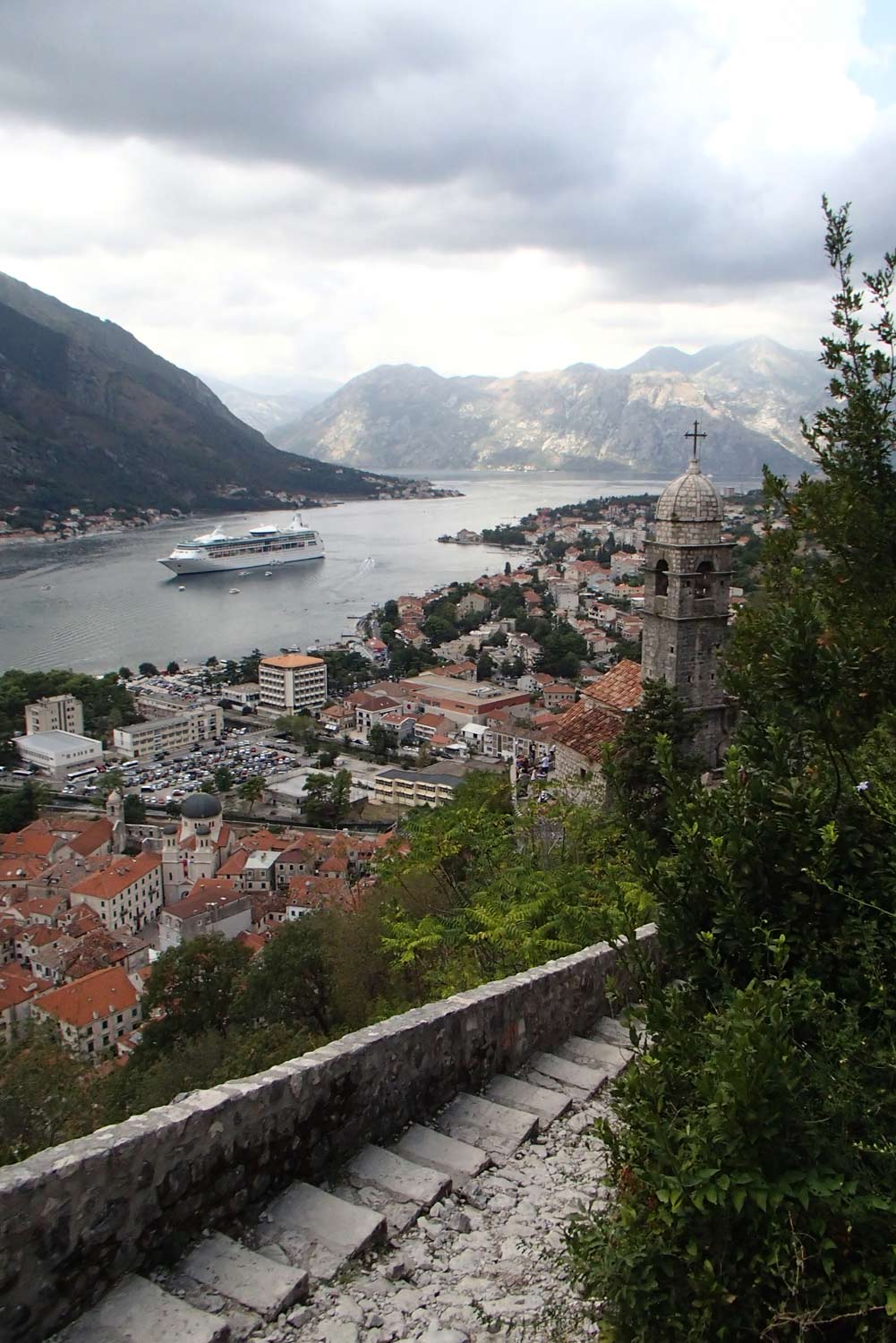
View from the Kotor fortress
View from the Kotor fortress — the walled city and bay from above · © Delphine Camberlin

Croatia and Bosnia-Herzegovina represent the two most visited parts of the Balkans — and the two most contrasting. Croatia offers the Adriatic coastline: the UNESCO-walled city of Dubrovnik, the Roman palace at Split where a Roman emperor retired and a medieval city grew inside his walls, the island-hopping of the Dalmatian coast. Bosnia is inland and Ottoman, entirely different in feel — mosques and minarets, the culture of coffee-house conversation, and Sarajevo's extraordinary layering of civilisations in a single city.

Dubrovnik — the most photographed city in the Adriatic and, since Game of Thrones used it as King's Landing across eight seasons, probably the most recognised walled city in the world. The medieval walls (14th-century limestone, entirely intact, 2km in circumference, walkable) enclosing the old town, the Stradun marble pedestrian street polished to a shine by centuries of feet, and the views from the walls over the orange-tiled roofs and Adriatic blue are genuinely extraordinary. The price of this fame is extreme: in summer, Dubrovnik receives up to 10,000 cruise ship passengers per day, and the old town becomes a heaving corridor of tour groups. Visit in May or October, arrive at 7am before the day-trippers, and stay in the old town rather than commuting from the resorts. The city rewards those who arrive early and stay late enough to see it in the evening light, when the day-trip crowds have gone.

Split — Croatia's second city and a more authentic daily-life version of Adriatic living. The Diocletian's Palace — a Roman emperor's retirement complex built in the 4th century CE — is not preserved as a ruin but lived in: apartments, restaurants, a cathedral (the emperor's mausoleum, converted), bars, and market stalls occupy rooms that were once imperial chambers. Wandering the alleys inside the palace walls at night, when the tourist flow drops and the local restaurants fill, is one of the finest urban experiences in the Balkans. Split is also the main departure point for the Dalmatian island ferries (Hvar, Brač, Korčula).

Plitvice Lakes National Park — Croatia's most visited natural site, and among the most beautiful lake systems in Europe: 16 terraced lakes connected by waterfalls, in colours ranging from turquoise to emerald to grey-blue depending on the mineral content and the light. UNESCO-listed. The wooden boardwalks traverse the waterfalls at close range — this is genuinely exceptional. Book tickets online at least 2 weeks in advance in summer; the park controls daily visitor numbers strictly.

Sarajevo — the most intellectually fascinating city in the Balkans, and the one that rewards staying the longest. The capital of Bosnia-Herzegovina is a city where a 15th-century Ottoman bazaar (Baščaršija) stands a 10-minute walk from the 1890s Austro-Hungarian administrative quarter, which stands a 5-minute walk from socialist-era apartment blocks, which stand next to buildings still bearing the bullet holes and shrapnel scars of the 1992–1996 siege. The Latin Bridge — where Archduke Franz Ferdinand was assassinated on 28 June 1914, the shot that triggered World War One — is a small, unassuming bridge with a museum on the corner. The Sarajevo Tunnel Museum, in a private house on the southern edge of the city, commemorates the 800-metre tunnel dug under the airport to maintain a supply line during the 1,000-day siege — one of the most moving and human monuments in the Balkans. Sarajevo is also where the coffee culture is most intense: Bosnian coffee (finely ground, unfiltered, brought to a boil in a džezva, poured slowly into a small cup with a sugar cube) is drunk at every occasion, and sitting in a čajna kuća (tea and coffee house) on the Baščaršija for an hour is an experience of unhurried time that feels genuinely different from Western European café culture.

Mostar — the Stari Most (Old Bridge) is one of the most graceful pieces of Ottoman engineering in the world: a single-arch white stone bridge of extraordinary elegance spanning the Neretva River, destroyed in 1993 during the Bosnian War and rebuilt to the original design in 2004. It is a symbol of reconstruction and coexistence. The old bazaar around it, the dervish house of Blagaj carved into the cliff beside a river source, and the contrast between the heavily touristed bridge and the genuinely working neighbourhood streets just above it make Mostar a more complex place than it first appears.

Stone bridge
Stone bridge — the Ottoman heart of the western Balkans · © Delphine Camberlin

Croatia & Bosnia Tips

  • Dubrovnik: avoid July–August if crowds are a concern. May and October give near-identical weather with a fraction of the visitors. Walk the walls at 8am for the best light and before the tour groups arrive
  • Split: Diocletian's Palace is best explored without a guide — just walk, get lost, find bars inside Roman cellars
  • Plitvice Lakes: buy tickets online minimum 2 weeks ahead in summer; arrive at opening time (7am) for morning mist and empty walkways
  • Bosnia is remarkably cheap — cevapi (grilled meat in flatbread) costs about €2–3 at a Sarajevo buregdžinica; a full dinner with wine rarely exceeds €12
  • Note on Kosovo border crossing: if you enter Kosovo from Serbia, you cannot then enter Serbia on the same trip — Serbia does not recognise the Kosovo–Serbia border as valid entry. Plan your itinerary to visit Kosovo before Serbia or skip the crossing entirely
Region 02

Montenegro & Albania — The Adriatic's Wildest Coasts

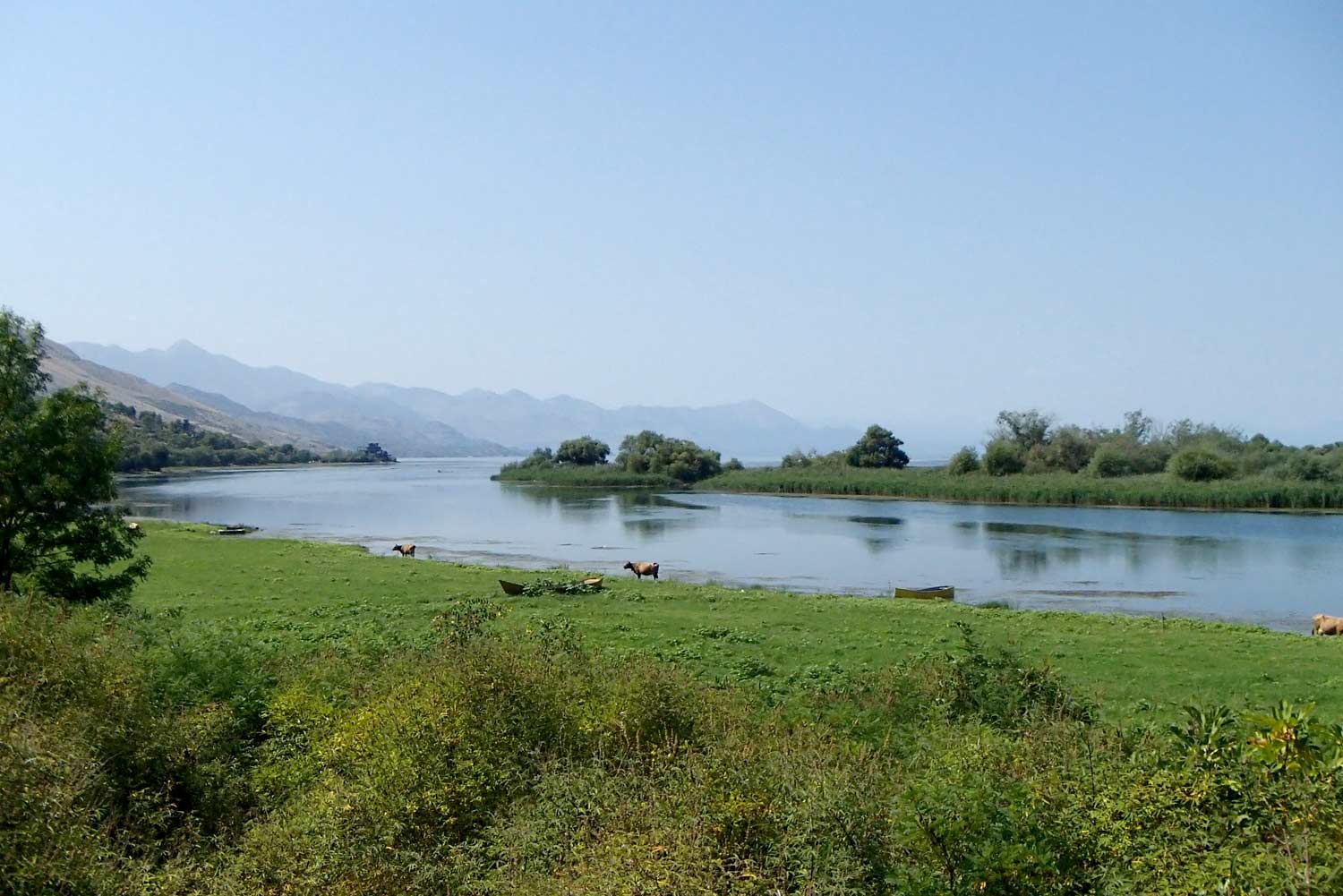
Albania–Montenegro border lake
Albania–Montenegro border lake — wild country at the edge of the Adriatic · © Delphine Camberlin

Montenegro and Albania are two of the most visually dramatic countries in the Balkans and, outside Croatia, the most rewarding for landscape photography. Montenegro packs a genuinely astonishing variety into an area smaller than Wales: the Bay of Kotor (a drowned canyon that looks like a fjord, surrounded by medieval walled towns and Venetian forts), the Durmitor mountains and Tara River canyon, and the Adriatic coast. Albania is harder to reach, less visited, and more rewarding for exactly those reasons.

Kotor, Montenegro — the Bay of Kotor is the defining visual of Montenegro: dark limestone mountains plunging directly into still water, with the medieval town of Kotor at the innermost point behind its remarkably intact Venetian walls. The town walls themselves climb the mountain above the old town to a fortress — the 1,350 steps are a serious climb rewarded with a panoramic view over the entire bay. Perast, a tiny village further around the bay, is achingly beautiful at dusk, its baroque palaces and campanile reflected in the still water. The approach to Kotor by boat — whether by private hire or the Kotor Bay cruise from Dubrovnik — is one of the finest maritime arrivals in the Mediterranean.

Durmitor National Park, Montenegro — the highlands of Montenegro are a completely different character from the coast: alpine meadows, glacial lakes (Black Lake — Crno Jezero — perfectly reflects the surrounding pine forest and mountains), limestone peaks above 2,500m, and the Tara River Canyon — the deepest canyon in Europe (1,300m) and second only to the Grand Canyon in the world. White water rafting on the Tara, the Bobotov Kuk summit hike, and the ski resort of Žabljak make Durmitor one of the finest wilderness areas in southeastern Europe.

Albania — the most unexpectedly rewarding country in the Balkans for those willing to get there. Albania was the most isolated country in Europe for most of the 20th century: Enver Hoxha's paranoid communist dictatorship (1944–1985) built 750,000 concrete bunkers across the country (roughly one for every four inhabitants), banned religion, severed all outside contact, and left behind a society that is only now fully opening. The result is a country with extraordinary natural beauty, ancient history, and almost no tourist infrastructure compared to its neighbours — which means the Albanian Riviera (a coastline of extraordinary clarity and colour, with villages like Himara and Dhërmiu that look more like the Greek islands than anything in Western Europe), the UNESCO-listed Ottoman city of Gjirokastër, and the medieval fortress town of Berat ("the city of a thousand windows" where Ottoman houses step up the hillside in layered symmetry) remain essentially undiscovered by mass tourism.

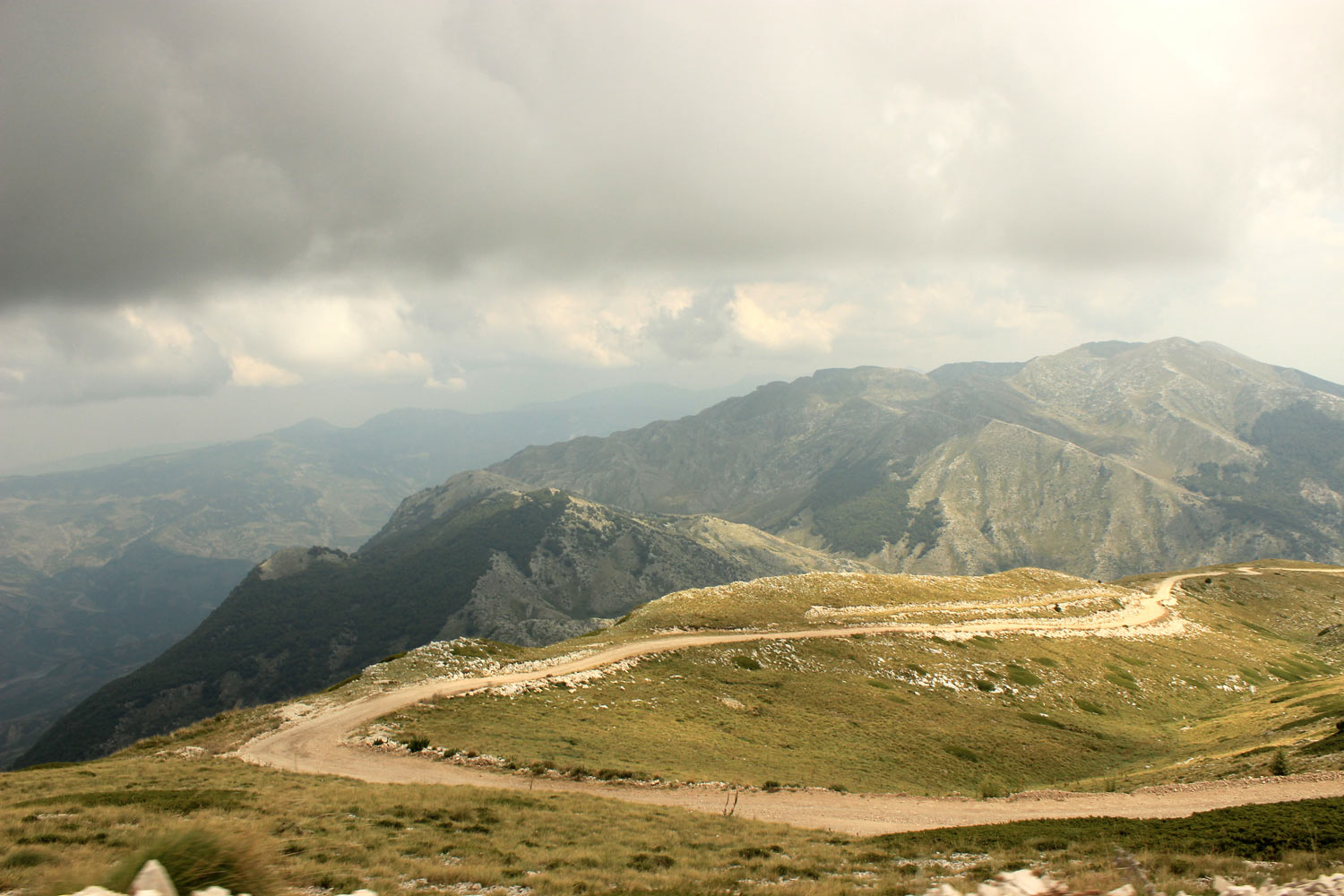
The Accursed Mountains (Bjeshkët e Namuna) in northern Albania — the Albanian Alps — contain some of the finest multi-day hiking in Europe: the Peaks of the Balkans trail (a 192km circuit crossing Albania, Kosovo, and Montenegro) passes through landscapes of extraordinary wildness and through communities where traditional mountain hospitality (Besa — an Albanian customary code of honour requiring hospitality to guests, even enemies) creates encounters of genuine warmth. Lake Shkodra (Shkodër), shared with Montenegro, is the largest lake in the Balkans and a birdwatching destination of European significance.

Albanian mountain
Albanian mountain — dramatic landscapes barely touched by mass tourism · © Delphine Camberlin

Montenegro & Albania Tips

  • Kotor Bay is best photographed from the water — hire a small boat from Kotor or take the morning cruise from Herceg Novi
  • Albania: rent a car — public transport connects major cities but the Albanian Riviera, Berat, and Gjirokastër are all best reached independently
  • Berat and Gjirokastër are each UNESCO-listed; both deserve a full day minimum — Berat's castle district and Gjirokastër's bazaar are the finest Ottoman townscapes outside Turkey
  • The Albanian Riviera (Himara, Dhërmiu, Sazan Island) from May to early July before the crowds — water clarity rivals the Caribbean
  • The Peaks of the Balkans trail requires 10–14 days and excellent fitness; guided versions depart from Shkodra, Peja (Kosovo), and Theth (Albania)
Serbia, Kosovo & North Macedonia — The Overlooked Heart of the Balkans

Belgrade, Serbia — Europe's most underrated capital, and one of its most energetic. The confluence of the Sava and Danube rivers gives the city a dramatic geographical setting; the Belgrade Fortress (Kalemegdan) occupying the headland between the two rivers offers one of the great urban viewpoints in southeastern Europe. Belgrade's character is shaped by its history as the capital of Yugoslavia — the largest, most complex, and most cosmopolitan of the post-war communist states — and by its experience of NATO bombing in 1999, which left scars still visible on certain government buildings. The Skadarlija neighbourhood (the bohemian quarter) is the liveliest restaurant street in the city, dense with live traditional music. Belgrade has the finest nightlife in the Balkans — the floating nightclubs (splavovi) moored on the rivers are a Belgrade institution. The House of Flowers (Dom Cvetova) — Josip Broz Tito's mausoleum, with his tomb surrounded by gifts from world leaders — is the most fascinating monument to 20th-century non-aligned politics in Europe.

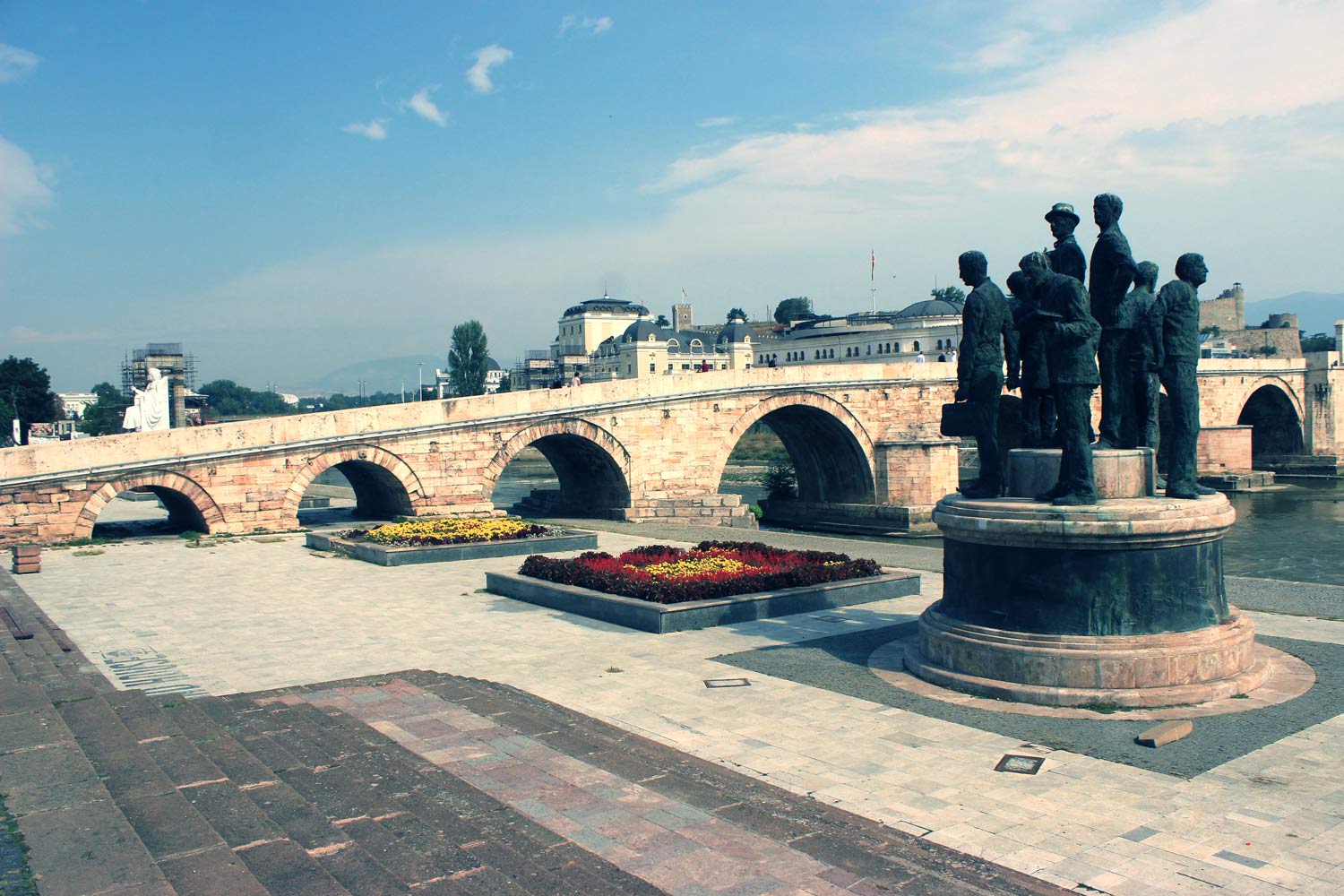
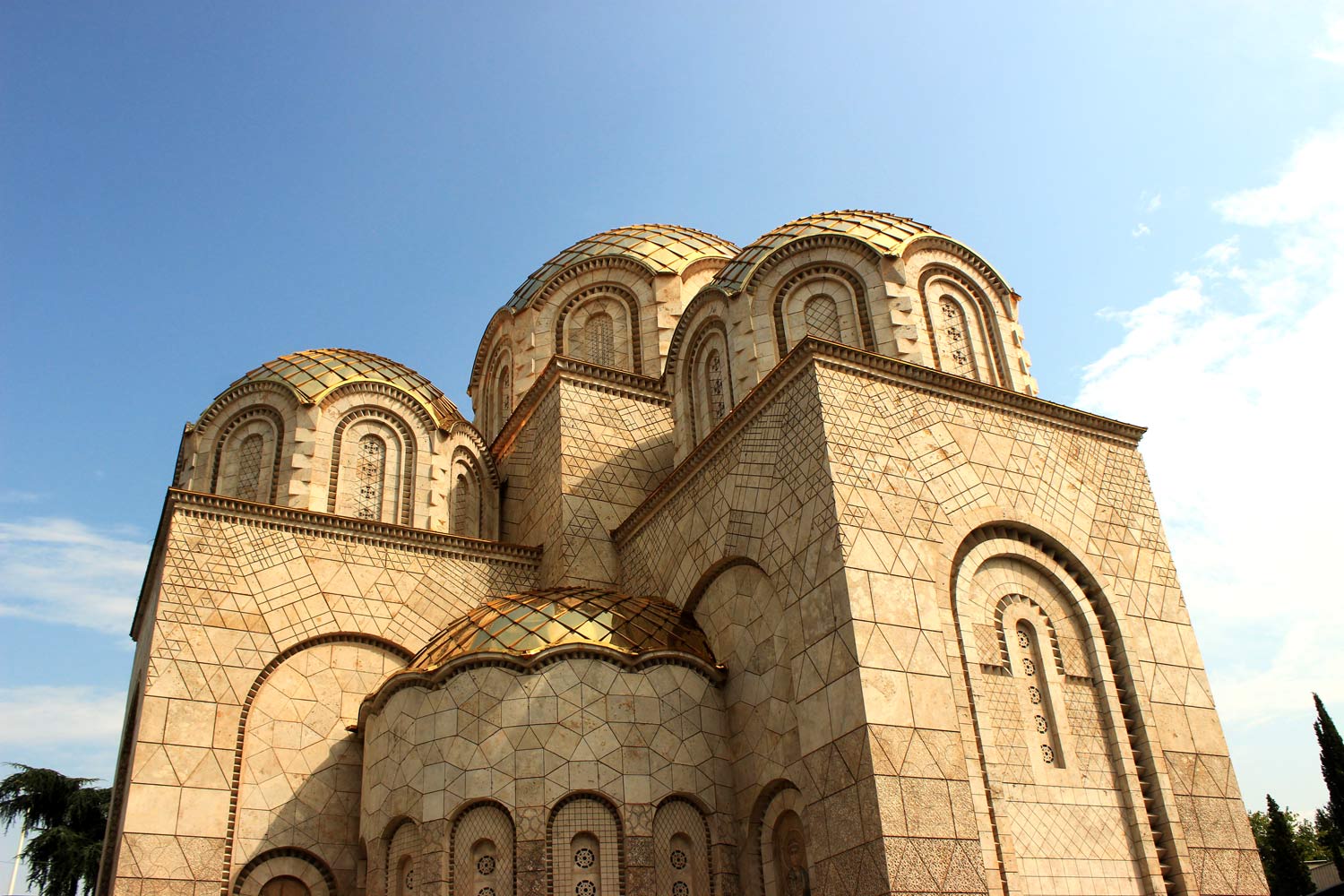
Skopje monument
Skopje monument — North Macedonia's capital blends Ottoman old town with bold contemporary architecture · © Delphine Camberlin

Kosovo — Europe's newest country (declared independence in 2008, recognised by over 100 states but not by Serbia or Russia, creating a complex entry/exit situation — see practical tips). Kosovo is small, entirely landlocked, and largely unknown to Western tourists, which makes it one of the most rewarding discoveries in the Balkans. The capital, Pristina, has a raw, energetic quality — new construction next to Ottoman mosques and communist-era monuments, a population that is remarkably young (Kosovo has the youngest demographic in Europe, median age around 29) and enthusiastically outward-looking. Prizren — the old city in southern Kosovo, with Ottoman bridges, a bazaar, and a fortress above the town — is one of the most beautiful small cities in the western Balkans. The Serbian Orthodox Patriarchate of Peć, surrounded by medieval frescoes of extraordinary quality in a green valley, is UNESCO-listed and spiritually significant well beyond Kosovo's borders.

Lake Ohrid & North Macedonia — Ohrid is one of the great undiscovered lakes of Europe: one of the oldest lakes in the world (estimated 4–5 million years old, with endemic species found nowhere else), 30km long, at an altitude of 693m in the mountains of North Macedonia, surrounded by Byzantine churches and UNESCO-listed medieval architecture. The church of St John at Kaneo on its rocky promontory above the lake at sunset is one of the most-photographed scenes in the Balkans, and deservedly so. The old city of Ohrid (also UNESCO-listed) has more churches per square metre than any other city in the world — 365, one for each day of the year, though most are now ruins. The Matka Canyon, near Skopje, offers spectacular hiking, boat trips through narrow gorges, and cave diving in a spectacular karst landscape.

Lake Ohrid
Lake Ohrid — one of the oldest lakes in Europe surrounded by Byzantine churches · © Delphine Camberlin

Bulgaria — often grouped with the Balkans but frequently overlooked on the classic circuit. The rose valley (Kazanlak) in spring, when the Rosa damascena fields are harvested for attar (Bulgaria produces 70–80% of the world's rose oil), is one of the most extraordinary seasonal experiences in Europe. Sofia's compact historic centre layers Thracian, Roman, Byzantine, and Ottoman archaeology almost visibly. The Rila Monastery — a UNESCO-listed Bulgarian Orthodox complex in a mountain valley, with extraordinary frescoes covering every external surface — is the most significant religious monument in Bulgaria and one of the most beautiful in the Balkans.

Understanding the Balkans — History You Need to Know

The Balkans are Europe's most historically complex region, and visiting without some contextual knowledge is to miss the deepest layer of what makes them compelling. The word "Balkans" derives from the Turkish for "mountain," which reflects both the geography and the Ottoman legacy that shaped the region for 500 years. Almost every country here carries the marks of at least four empires — Roman, Byzantine, Ottoman, and Austro-Hungarian — and the collision of Orthodox Christianity, Catholicism, and Islam that resulted from this history remains visible in the streetscape of every major city.

Ottoman stone bridge
Ottoman stone bridge — the legacy of 500 years of empire visible in every town of the western Balkans · © Delphine Camberlin

The Ottoman legacy — the Ottoman Empire controlled most of the Balkans for between 400 and 500 years (roughly 1350–1878 for the western and northern areas, longer in the south). The Ottoman period left mosques, bazaars, coffee-house culture, culinary traditions (cevapi, burek, baklava), and a religious map of extraordinary complexity: Muslim majorities in Bosnia and Kosovo, mixed Muslim-Orthodox-Catholic communities throughout, and the legacy of the devshirme system (through which talented Christian boys were taken into Ottoman service and could rise to the highest offices of the empire). The resentment of Ottoman rule and the struggle for independence in the 19th century created the political instability that led directly to World War One — the assassination of Archduke Franz Ferdinand in Sarajevo in 1914, the trigger for the war that killed 20 million people, is inseparable from this history.

Yugoslavia and its dissolution — the former Yugoslavia (founded 1918, reconstituted after WWII under Josip Broz Tito) was the largest and most complex attempt to unite the South Slavic peoples in a single state. Tito's Yugoslavia was genuinely different from the Soviet-aligned communist states — non-aligned, relatively open to Western visitors, with a consumer culture and a degree of personal freedom that was unusual in communist Europe. After Tito's death in 1980, the Yugoslav federation began to fracture along ethnic and religious lines. The dissolution (1991–1992) and the wars that followed — in Slovenia (10 days), Croatia (1991–1995), Bosnia (1992–1995, the most devastating, with the Srebrenica massacre of July 1995 — the worst act of genocide in Europe since the Holocaust — and the 1,000-day siege of Sarajevo), and Kosovo (1998–1999) — left scars on the landscape and in the population that remain raw. Understanding this context makes every bullet-hole scar, every rebuilt bridge, and every museum that much more significant.

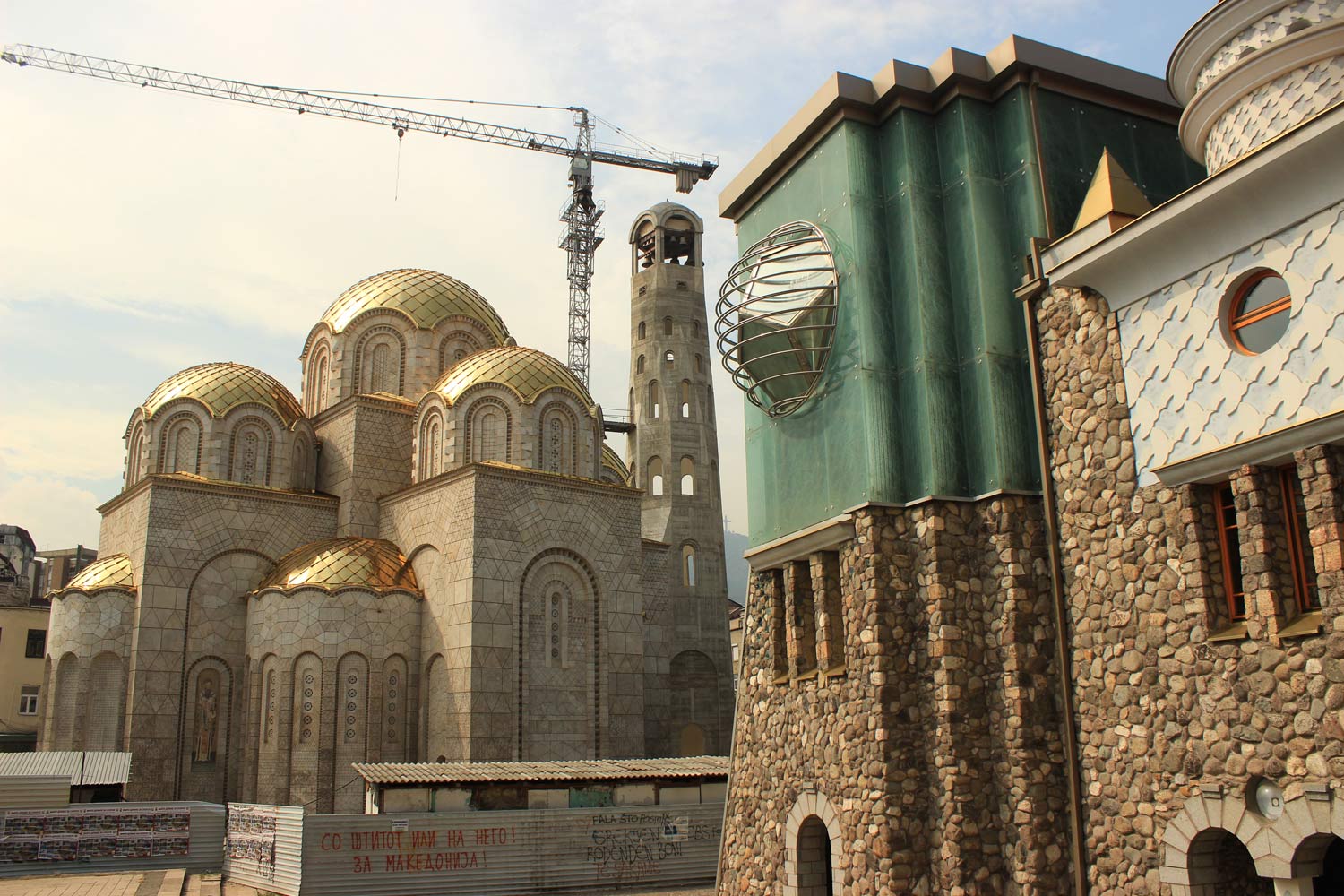
Memorial House of Mother Teresa Skopje
Memorial House of Mother Teresa Skopje — born Anjezë Gonxhe Bojaxhiu in 1910 in what is now North Macedonia · © Delphine Camberlin

Visiting the memorials — the Tuol Sleng-equivalent of the Balkans — requires care and respect. The Tunnel Museum in Sarajevo, the Srebrenica Memorial and Cemetery, the war-damaged buildings deliberately preserved in Mostar and Sarajevo, and the Kosovo War memorials are genuinely important places to visit, and local guides who are survivors or children of survivors can provide a depth of personal testimony that no guidebook can.

Balkan Food & Culture — Ćevapi, Burek, Rakia & the Coffee Ritual

Balkan food is one of Europe's most consistently underrated culinary traditions — hearty, flavourful, shaped by Ottoman technique and local ingredients, and almost universally cheap. It shares deep roots across all the countries of the region, with local variations that make exploring the differences rewarding.

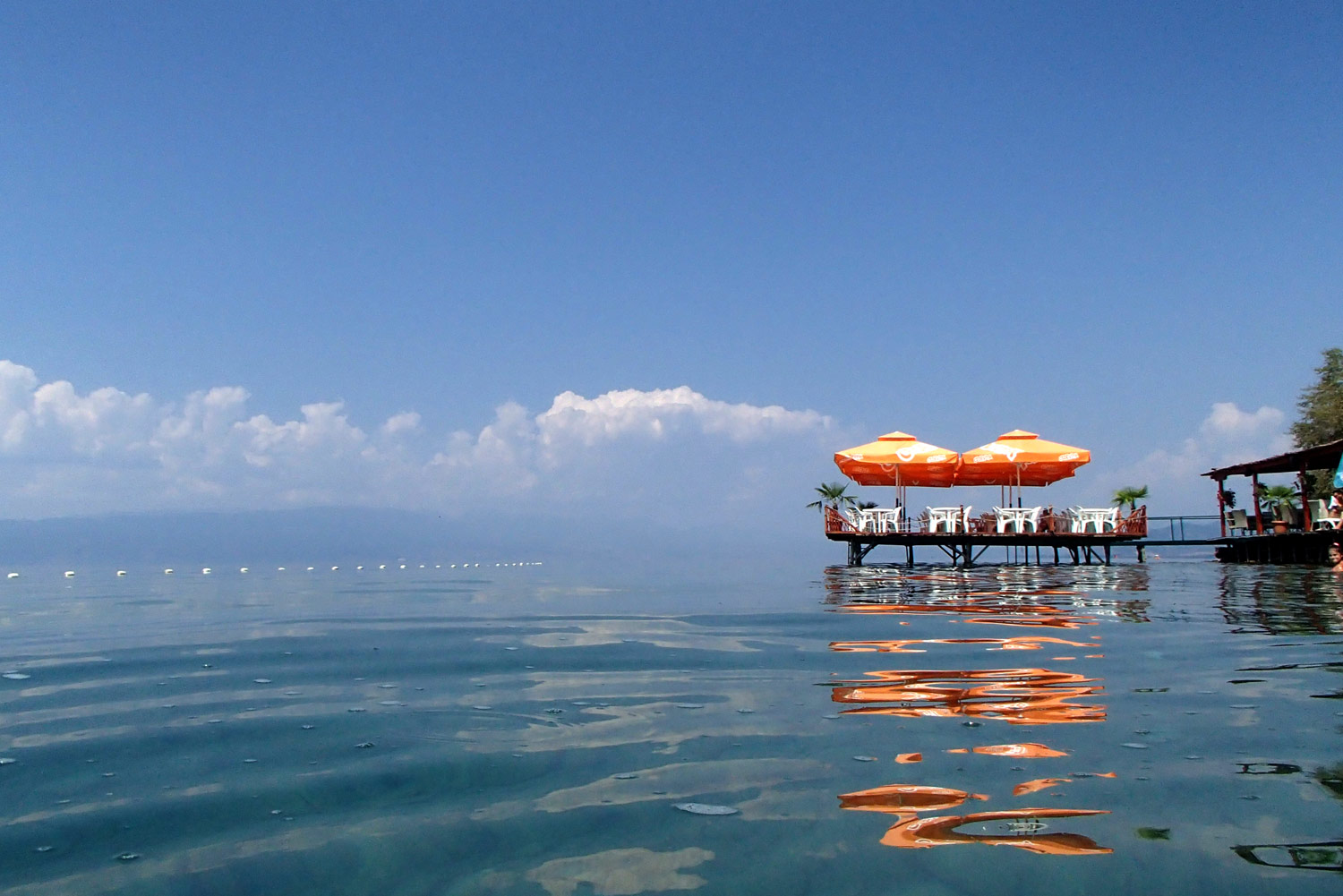
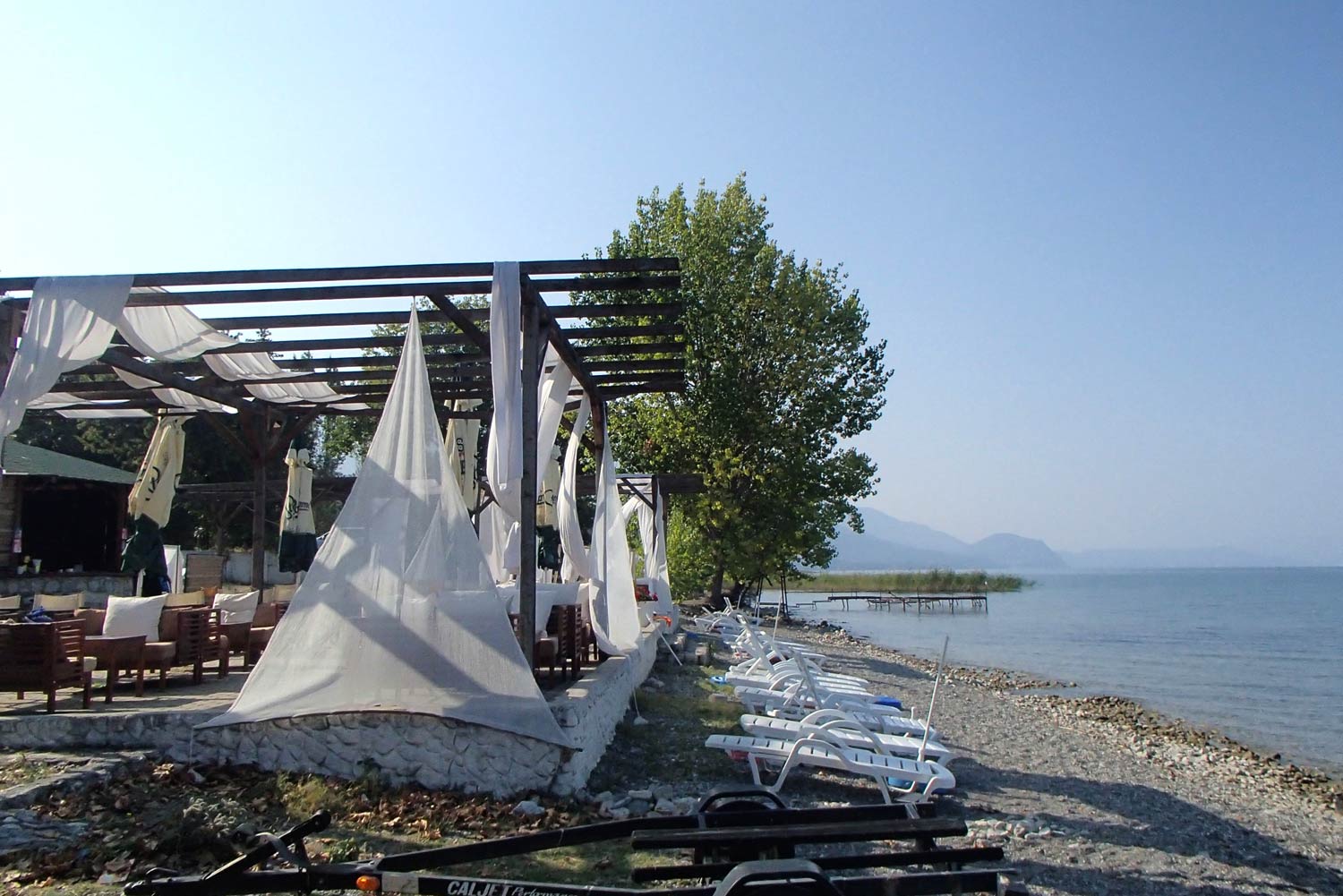
Outdoor terrace Lake Ohrid
Outdoor terrace Lake Ohrid — Balkan café culture at its most unhurried · © Delphine Camberlin

Ćevapi — the defining food of the western Balkans: small, hand-shaped grilled meat sausages of minced beef and lamb (or pork, outside Muslim-majority areas), served in a warm flatbread (somun or lepinja) with raw onion, ajvar (roasted red pepper relish), and kajmak (a slightly soured cream cheese). In Sarajevo, a proper plate of ćevapi at a buregdžinica costs around €3 and is one of the finest things to eat in southeastern Europe. Every city in the region has its own version and its passionate partisans.

Burek — flaky filo pastry filled with minced meat (burek), cheese (sirnica), spinach (zeljanica), or potato, baked in a spiral coil and sold by weight at bakeries from morning. A burek breakfast — torn up with yogurt poured over it — is the morning meal of half the western Balkans, and the correct response to a hangover anywhere from Sarajevo to Skopje.

Rakia (Rakija) — the spirit of the Balkans, distilled from fruit (most commonly plum — šljivovica — but also grape, apple, quince, pear, and walnut). Every family in Serbia, Bosnia, North Macedonia, and Bulgaria makes their own; every restaurant has a house version; and offering or receiving a glass of rakia is a social gesture of hospitality that crosses every cultural and religious division in the region. The quality of homemade rakija varies from extraordinary to extraordinary-in-a-different-way. Accept every glass.

Ajvar — roasted red pepper relish, made in industrial quantities by Balkan families in September when the peppers are at their best, and eaten throughout the year. The smell of roasting peppers in September in any Balkan city is one of the great seasonal signatures of the region. Commercial versions exist but are inferior to the homemade product by a significant margin.

Bosnian coffee — the coffee culture of Bosnia, inherited from the Ottomans, is a social institution as much as a beverage. Bosnian coffee (bosanska kafa) is prepared by boiling finely ground coffee in a small džezva, poured slowly into a finjan (small cup) alongside a sugar cube and a piece of lokum (Turkish delight) or a ratluk sweet. The ritual of drinking it — slowly, in conversation, without hurry — is the most visible expression of Bosnian culture's Ottoman inheritance.

Regional variations worth seeking — Croatia's Istrian and Dalmatian coasts have an Italian-influenced cuisine (fresh seafood, olive oil, peka — meat and vegetables slow-cooked under a bell-shaped lid buried in embers — is the Dalmatian equivalent of a lovo feast); Serbia's interior offers hearty meat dishes, white Feta-style cheese, and the powerful spirit tradition; North Macedonia's Lake Ohrid trout (pastrmka) is one of the finest freshwater fish in Europe; Albanian cuisine features excellent lamb prepared with yogurt and wild herbs, and byrek (the Albanian version of burek) stuffed with gjizë (a fresh cheese unique to Albania).

Practical Balkans — What You Need to Know Before You Go
  • Currencies: Croatia uses the Euro; Montenegro uses the Euro (unilaterally, not officially EU); Bosnia uses the convertible mark (BAM, pegged to Euro); Serbia uses the Serbian Dinar; North Macedonia the Denar; Albania the Lek; Kosovo uses the Euro. Carry some cash — rural areas, markets, and small restaurants often don't accept cards
  • Kosovo–Serbia border issue: if you enter Kosovo from Serbia (or exit to Serbia), Serbia may deny you entry on a future visit because they don't recognise the Kosovo–Serbia crossing as an official border. Plan to enter Kosovo from North Macedonia or Albania and exit the same way if you plan to visit Serbia
  • Getting around: a rental car is the finest way to explore the region independently — roads have improved dramatically, distances between highlights are manageable, and the freedom to stop at roadside mezelik stalls and viewpoints is worth the cost. Buses connect major cities; rail is limited and slow outside Croatia and Serbia
  • Cost: the Balkans are among the cheapest destinations in Europe. Outside Croatia (which has aligned with Western European prices), a mid-range daily budget of €40–60 covers comfortable accommodation, excellent meals, and transport. Albania and North Macedonia are the cheapest; Croatia and Montenegro's coasts the most expensive
  • Language: Serbo-Croatian (called Serbian, Croatian, or Bosnian depending on country — mutually intelligible dialects) covers Croatia, Bosnia, Serbia, and Montenegro. Albanian is spoken in Albania and Kosovo. Macedonian in North Macedonia; Bulgarian in Bulgaria. English is spoken by younger generations throughout; older generations in rural areas may have none. Some German is useful in Croatia from the Austrian influence
  • Safety: the Balkans are generally very safe for tourists. Petty theft exists in tourist areas (Dubrovnik, Belgrade) as in all of Europe. Landmines remain a serious hazard in parts of Bosnia — stick to marked paths and never enter areas marked with mine warnings
  • Smoking: indoor smoking is significantly more common than in Western Europe, particularly in Serbia, North Macedonia, and Albania. If smoke is a health concern, sit outside

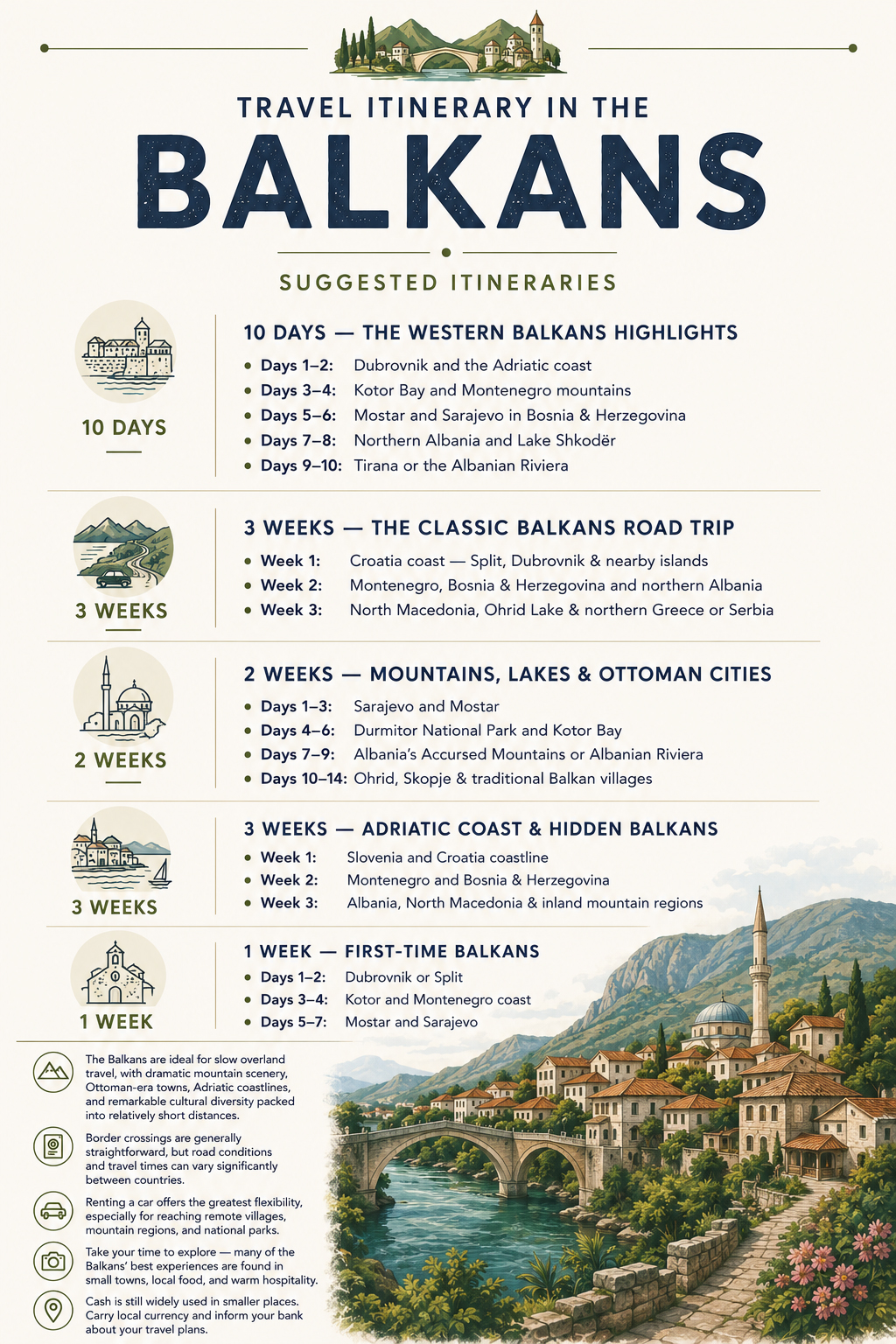
Suggested Itineraries in the Balkans

10 days — The Western Balkans Highlights

  • Days 1–2: Dubrovnik and the Adriatic coast
  • Days 3–4: Kotor Bay and Montenegro mountains
  • Days 5–6: Mostar and Sarajevo in Bosnia & Herzegovina
  • Days 7–8: Northern Albania and Lake Shkodër
  • Days 9–10: Tirana or the Albanian Riviera

3 weeks — The Classic Balkans Road Trip

  • Week 1: Croatia coast — Split, Dubrovnik & nearby islands
  • Week 2: Montenegro, Bosnia & Herzegovina and northern Albania
  • Week 3: North Macedonia, Ohrid Lake & northern Greece or Serbia

2 weeks — Mountains, Lakes & Ottoman Cities

  • Days 1–3: Sarajevo and Mostar
  • Days 4–6: Durmitor National Park and Kotor Bay
  • Days 7–9: Albania’s Accursed Mountains or Albanian Riviera
  • Days 10–14: Ohrid, Skopje & traditional Balkan villages

3 weeks — Adriatic Coast & Hidden Balkans

  • Week 1: Slovenia and Croatia coastline
  • Week 2: Montenegro and Bosnia & Herzegovina
  • Week 3: Albania, North Macedonia & inland mountain regions

1 week — First-Time Balkans

  • Days 1–2: Dubrovnik or Split
  • Days 3–4: Kotor and Montenegro coast
  • Days 5–7: Mostar and Sarajevo
Itineraries in The Balkans

When are the Best Time To Visit the Balkans?

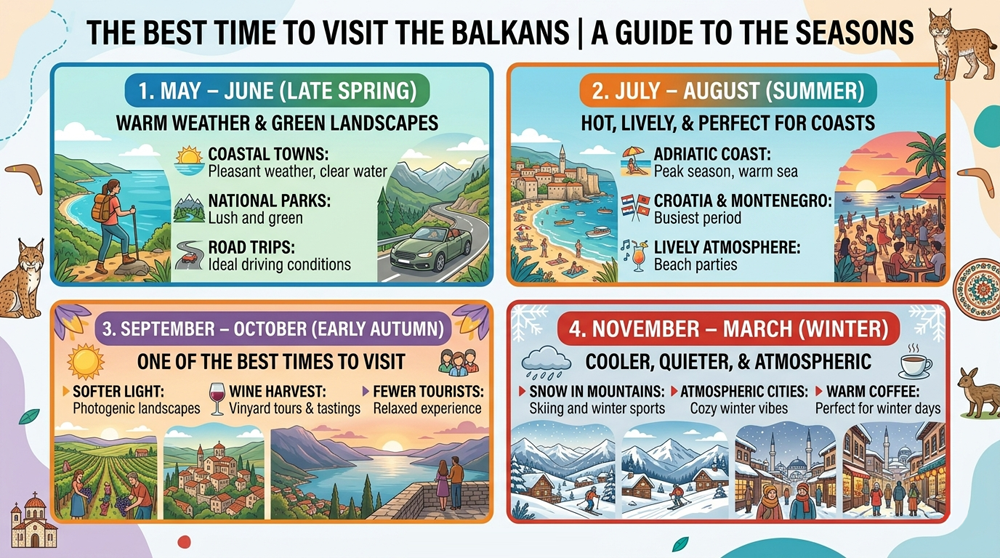
The Best Time to visit the Balkans

May – June

Warm weather, green landscapes, and fewer crowds before peak summer. Ideal for coastal towns, national parks, and road trips.

July – August

Hot, lively, and perfect for the Adriatic coast. Croatia, Montenegro, and Albania are busiest during this period.

September – October

One of the best times to visit — warm sea temperatures, softer light, wine harvest season, and fewer tourists.

November – March

Cooler and quieter. Mountain regions see snow, while cities like Sarajevo and Belgrade feel atmospheric in winter.

Visit the Balkans By Season & Region

The Balkans have a remarkably varied climate for such a compact region, shaped by the Adriatic coastline, high mountain ranges, inland plains, and Mediterranean influences. Summers can be intensely hot along the coast, while mountain regions remain cool and green even in mid-summer. Winters vary from mild on the Adriatic to snowy and continental inland. Because the region stretches across several countries and landscapes, the Balkans can be visited year-round depending on the style of trip you are planning.

Spring & Early Summer — April to June

Best Overall Time to Visit
These months offer the most balanced travel conditions across the Balkans, with pleasant temperatures, greener landscapes, and fewer tourists before the peak summer crowds arrive.

  • Exploring historic cities and old towns
  • Hiking in mountain national parks
  • Adriatic coastal road trips
  • Photography and outdoor activities
  • Visiting lakes, monasteries, and villages

Wildflowers bloom across mountain regions during late spring, particularly in Montenegro, Bosnia & Herzegovina, and northern Albania.

Summer — July to August

Hot Coastlines & Festival Season
Summer brings long sunny days and very warm temperatures, especially along the Adriatic coast where tourism peaks dramatically.

  • Beaches and island travel
  • Sailing and coastal photography
  • Festivals and nightlife
  • Mountain escapes at higher elevation

Temperatures along the coast often exceed 35°C, particularly in Croatia, Montenegro, and parts of Albania. Inland cities can also become very hot.

Autumn — September to October

Warm Seas & Softer Light
Early autumn is one of the best periods for travelling in the Balkans. Sea temperatures remain warm after summer, while tourist crowds decrease significantly.

  • Coastal towns become quieter and more relaxed
  • Vineyards and forests change colour beautifully
  • Hiking conditions improve again after summer heat
  • Photography light becomes softer and more atmospheric

September is often considered the perfect balance between weather and crowd levels.
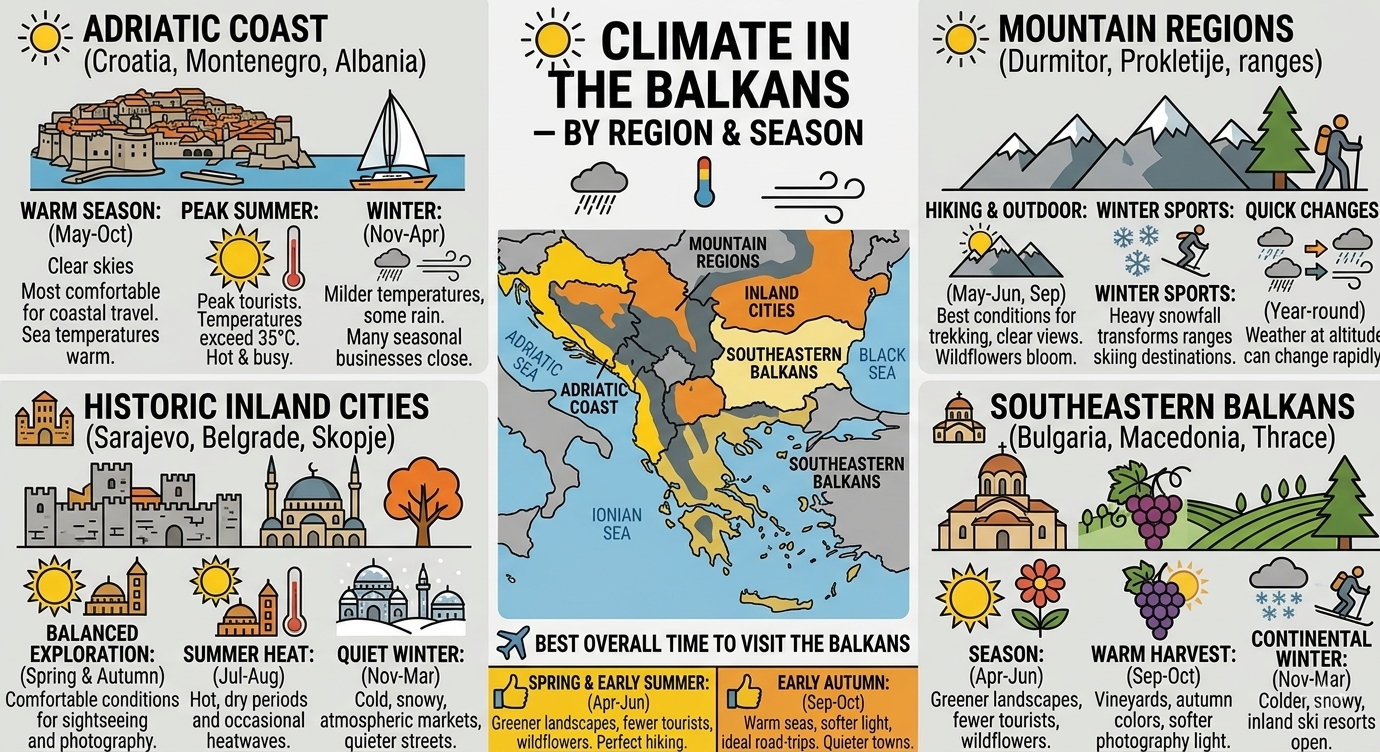
Climate in the Balkans

Winter — November to March

Snowy Mountains & Quiet Cities
Winter conditions vary greatly across the region.

  • Mountain regions receive heavy snowfall
  • Ski resorts open in Bosnia, Bulgaria, and Slovenia
  • Coastal areas remain relatively mild
  • Tourist numbers drop outside major cities

Some mountain roads and remote villages can become difficult to access during heavy snow periods.

📶 Stay Connected

Skip the SIM hunt on arrival. A travel eSIM lets you activate local data before you board — no plastic card, no roaming fees, instant setup. Roamic covers this destination and most countries in the Galerie.

Get Your Travel eSIM →
Find the perfect activities in The Balkans with GetYourGuide

A guided kayaking tour of Kotor Bay and a night walk through Dubrovnik's old city walls are the two things I'd book in advance — both fill up fast and the difference between a good and great guide here is significant.

Search and Book your flight to the Balkans with Kiwi.com

The Balkans reward a multi-country route — flying into Dubrovnik and out of Tirana (or Podgorica) makes for a far more logical trip than backtracking. Kiwi.com's multi-city search handles these open-jaw combinations better than most search engines.

Subscribe to the Newsletter

New quizzes, travel stories, and photography from 18 countries — straight to your inbox. One email at a time, no spam.

✓ Thanks! Check your inbox shortly.

Stock Photography

Asia Collection

Browse and license the full Asia photography collection — available for commercial and editorial use on Shutterstock.

View on Shutterstock →
Asia Collections Delphine Camberlin ShutterStock

Stock Photography

Arabic Style Collection

Browse and license the full Arabic Style photography collection — available for commercial and editorial use on Shutterstock.

View on Shutterstock →
Arabic Style Collections Delphine Camberlin ShutterStock