Belgium is one of Europe's most underestimated countries — and the Belgians would be the first to tell you that, with a dry smile and a glass of Delirium Tremens in hand. This is a country that invented a liqueur called Zizi Coin Coin, erected a small bronze statue of a peeing boy as its most iconic landmark, and built an enormous aluminium atom to celebrate science — then turned it into a tourist attraction. Belgium doesn't take itself too seriously, and that's precisely what makes it so charming.
But beneath the self-deprecating humour lies something genuinely extraordinary — three regions so culturally distinct they could almost be three different countries, held together by a love of good food, festivals, and the quiet pride of setting the global standard in chocolate and beer. Come hungry, and stay longer than you planned.
A country that invented 1,500 distinct beers and the praline, built a giant aluminium atom as a tourist attraction, made Tintin a national hero, and hides medieval cities barely touched by mass tourism — all within an area the size of Maryland.
Belgium — Map
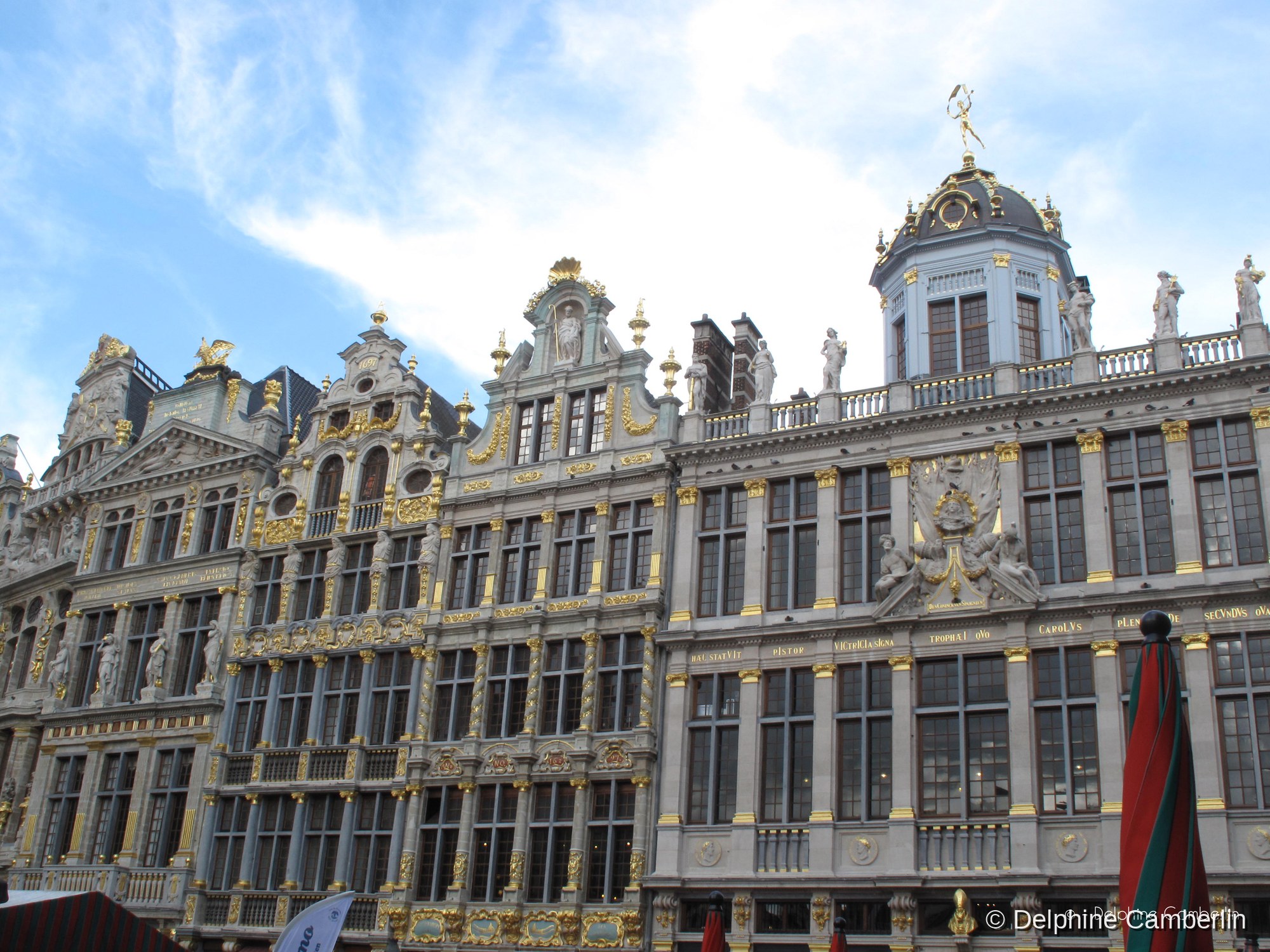
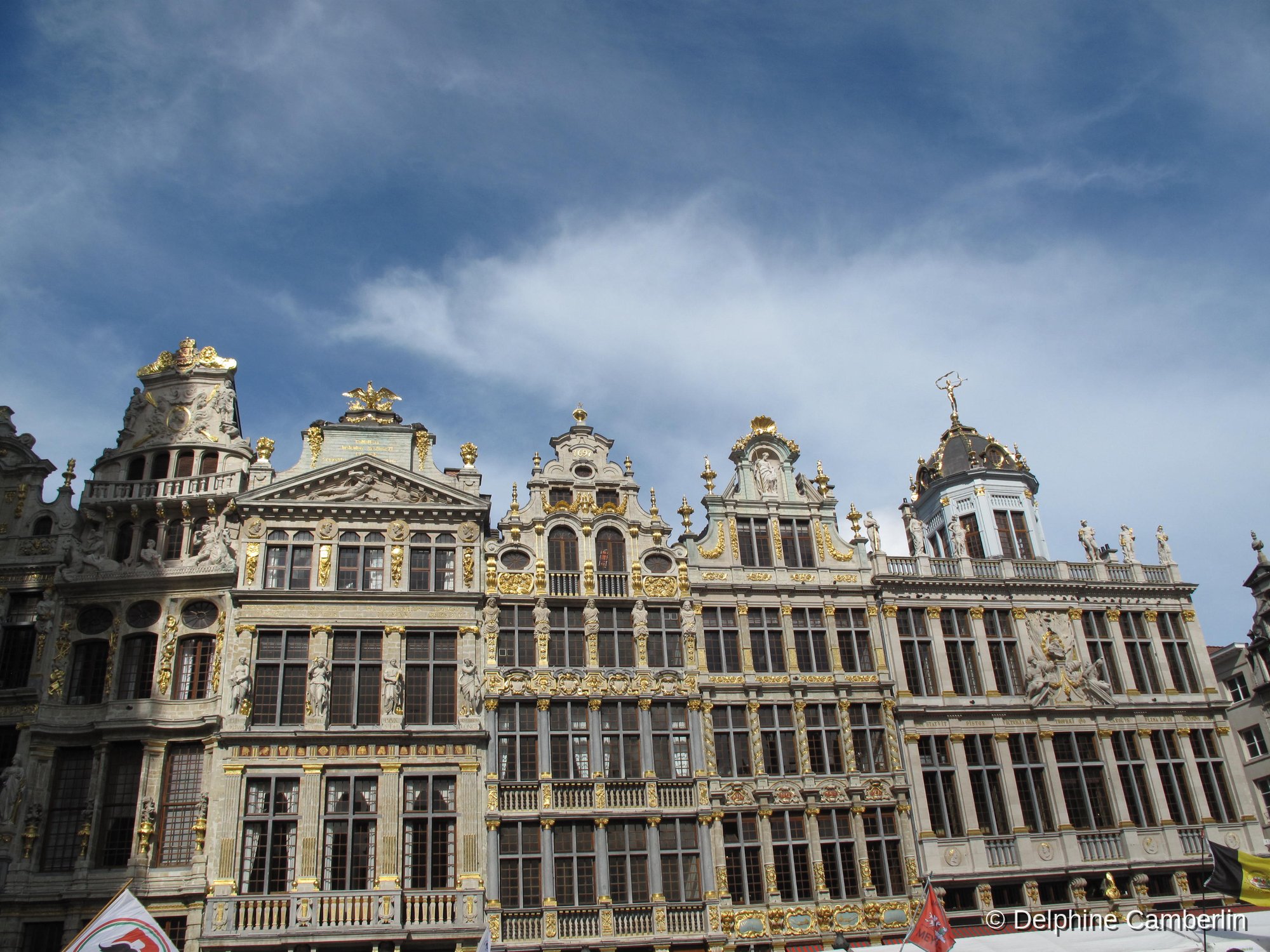
Brussels is a city of extraordinary contradictions — the bureaucratic capital of the European Union and simultaneously one of Europe's most irreverent, creative cities. The Grand-Place, framed by gilded Gothic guild houses, is arguably the most beautiful market square on the continent. The city operates at two speeds: the formal world of diplomats and international summits, and the real Brussels of Art Nouveau townhouses, jazz bars in the Ixelles commune, and late-night moules-frites eaten at zinc-topped tables.
The Grand-Place, framed by gilded Gothic guild houses, is arguably the most beautiful market square on the continent. A few streets away, the Manneken Pis — a tiny bronze boy urinating into a fountain — draws more visitors than many world-class museums. That contrast tells you everything about Brussels.
The architectural heritage here is staggering — Brussels produced some of the finest Art Nouveau buildings in the world, many designed by Victor Horta, whose sinuous organic facades remain in remarkable condition. The Maison de la Bellone, the Halles Saint-Géry, and the magnificent Bozar cultural centre reward those who simply walk without a plan.
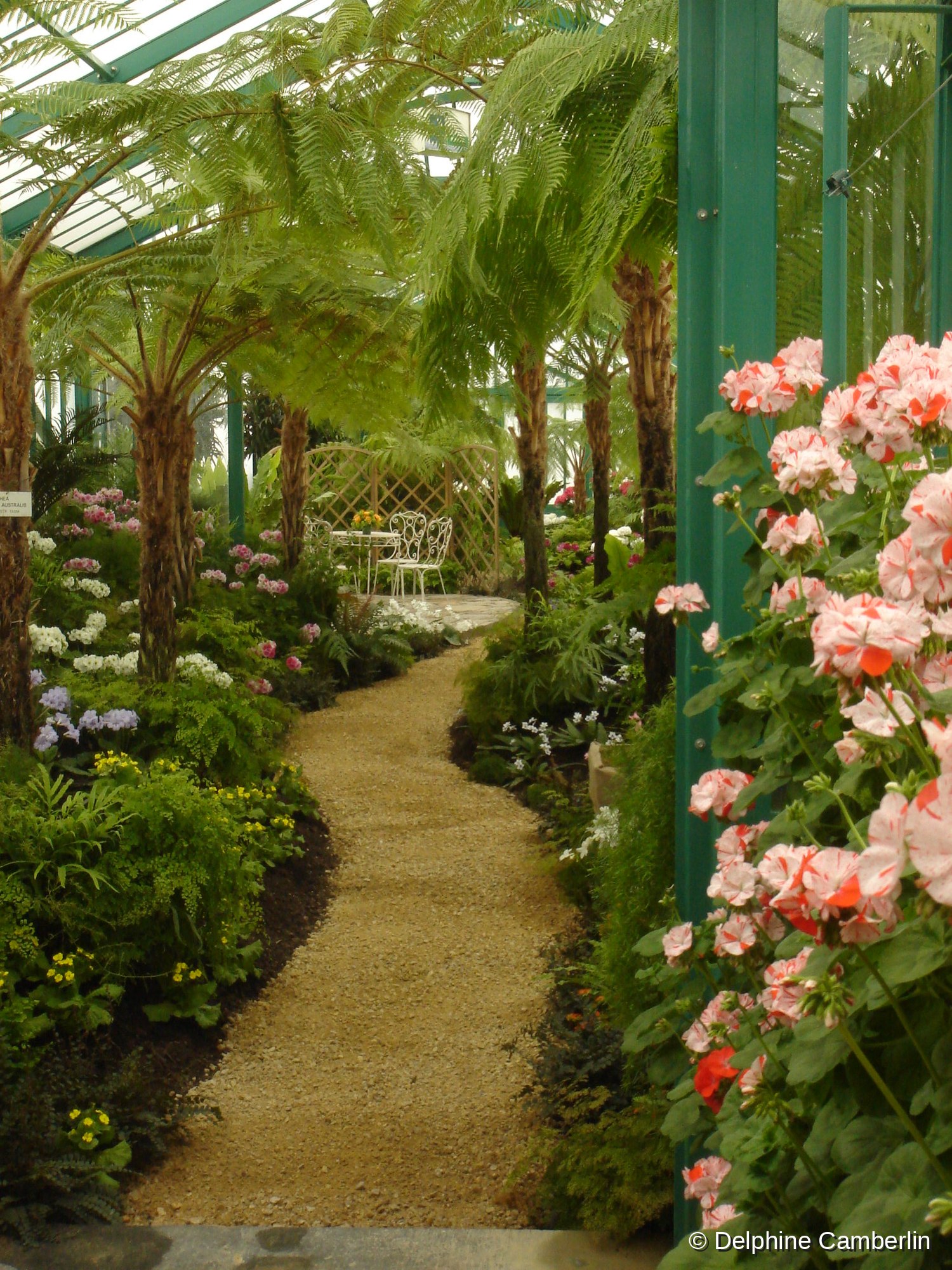
The southern communes of Brussels — Ixelles and Saint-Gilles — are where the city's real daily life unfolds: independent restaurants, jazz bars, covered markets, and the highest concentration of Art Nouveau townhouses anywhere in the world. The Horta Museum, in the architect's own former home on Rue Américaine, is one of the finest decorated interiors in Europe.
Les Apéros Urbains — every Friday in summer (19h–23h), thousands gather in a different Brussels neighbourhood for open-air after-work drinks. The Terrasse de l'Hippodrome in Ixelles, and Le Lac de Genval — a lake village 25 km southeast — are where locals go when the weather holds.
Belgium is one of the most compact and well-connected countries in Europe — small enough to cross by train in under two hours, yet rich enough in distinct culture, language, and landscape to reward weeks of exploration. Brussels is served by Eurostar direct from London, Thalys from Paris and Amsterdam, and ICE from Cologne. Within the country, the SNCB/NMBS rail network is excellent and affordable, making it entirely possible to base yourself in one city and day-trip to Bruges, Ghent, Liège, or the Ardennes. Car hire becomes worthwhile only if you're exploring the Ardennes or the quieter corners of the countryside.
| 🗓️ | Recommended stay | 5 – 10 days |
| 🎒 | Budget / day | €60–90 / $65–100Hostel or budget hotel, local brasserie lunches, rail travel |
| 🥂 | Luxury / day | €180–350 / $200–385Boutique hotel, Michelin-level dining, private tours |
| 📅 | Best months | April – June · September – October |
| 🌡️ | Climate | 5–23°C · Temperate maritime · Expect rain year-roundSummers mild and pleasant · Winters grey but festive |
| ✈️ | Visa | Schengen — EU / EEA free · US / UK visa-free 90 days |
| 💵 | Currency | EUR · Cards everywhere · Cash useful in rural Ardennes markets |
| 🚂 | Getting around | Excellent SNCB/NMBS rail between cities · Trams and metro in Brussels · Car for Ardennes |
| 🛡️ | Safety | Low — generally very safeNormal urban precautions in Brussels city centre · Some areas around Gare du Midi at night |
| 🍜 | Must-try food | Moules-frites, carbonnade flamande, waterzooi, speculoos, waffles (Liège-style — the best), and obviously: chocolate |
| 💬 | Language | Dutch (Flanders), French (Wallonia), German (East) · Brussels bilingual · English widely spoken everywhere |
Flanders is the Dutch-speaking north of Belgium — a region of medieval canal cities, flat polders stretching to the North Sea, and a cultural confidence rooted in centuries of artistic and commercial power. Bruges is the postcard: its network of medieval canals, belfry tower, and lace-draped shop windows make it one of Europe's best-preserved medieval cities. But Bruges rewards those who stay after the day-trippers leave — when the canal reflections go quiet and the lamplight turns the stone facades amber. Ghent is Flanders' other great city, less polished and more lived-in, with a university city energy, the Gravensteen castle rising dramatically from the city centre, and a nightlife and food scene that easily rivals any European capital.
The Belgian coast — De Kust — is a very Belgian affair: a long, flat strip of beach towns connected by the world's longest tramline, running 67 kilometres from De Panne to Knokke. The beach huts, North Sea light, and end-of-season quietness make it unexpectedly photogenic. Flanders also hosts Tomorrowland — the world's most spectacular electronic music festival — in the village of Boom each July, transforming a quiet corner of the countryside into a city of 400,000 people for a weekend.
● The Grand-Place, Brussels — one of the most photogenic squares in Europe, and entirely different in mood at different times of day. At dawn, with mist still on the cobblestones and before the tour groups arrive, the gilded guild houses catch the early light in a way that stops you mid-step. At night, the illumination turns the entire square into something theatrical. Come back several times.
● Bruges canal reflections — the classic view from the Rozenhoedkaai (Rosary Quay) looking toward the belfry tower is genuinely as beautiful in person as in photographs. The reflection of the stepped-gable houses in the still canal water at dusk, particularly in autumn when the trees add colour, is one of the finest compositions in Belgian photography.
● The Ardennes in autumn — the forests around Durbuy, La Roche-en-Ardenne, and along the banks of the Ourthe and Lesse rivers turn extraordinary colours from late September through November. The misty valleys at dawn, the rivers running over sandstone boulders, and the ancient stone village architecture make this one of Europe's most underrated autumn photography destinations.
● Le Diable de Crupet — the grotto statues and candles at Crupet, with the ex-voto wall and roses in the foreground, are genuinely hard to photograph badly. Come on an overcast morning. Barely known outside Belgium — one of Namur province's finest photography subjects.
● Les Gilles de Binche — the Carnival — Belgium's most spectacular folk festival, held each Shrove Tuesday in the small town of Binche. The Gilles — participants in extraordinary ostrich-feathered headdresses and traditional costumes — parade through the streets throwing blood oranges to the crowd. UNESCO-listed, genuinely unforgettable, and unlike anything else in Europe. A photography opportunity you'll remember for the rest of your career.
🎟️ GetYourGuide: "A few experiences I'd book in Belgium without hesitation: a chocolate-making workshop in Brussels, a guided boat tour of Bruges canals at dusk, and a craft beer tasting in a historic Trappist abbey."
Wallonia is the French-speaking south of Belgium — a region of deep river valleys, dense Ardennes forests, medieval citadels, and a warmth and directness that feels distinctly different from the quieter north. Liège is Wallonia's great city — a working-class, proudly eccentric metropolis on the Meuse river, with a fierce local identity, extraordinary street food at the Marché de la Batte (one of Europe's oldest and largest open-air markets), and a nightlife culture centred around the famous Le Carré district and the lively Place du Vaudree — where the pavement terrasses overflow until late into warm evenings. Liège also gave the world the Maison du Peket, a legendary bar-distillery specialising in peket (Belgian genever) — try the Zizi Coin Coin if you're feeling adventurous.
Beyond Liège, Wallonia opens into the Ardennes — a vast, hilly forested landscape of rivers, caves, and ancient stone villages. Durbuy claims to be the smallest city in the world, and in autumn, surrounded by flaming forest, you'd forgive it almost anything. La descente de la Lesse — a canoe trip down the river Lesse through forested gorges to Houyet — is one of Belgium's great outdoor experiences. Maredsous Abbey, hidden deep in the Namur countryside, has been brewing its famous Maredsous beer and producing abbey cheese since the 19th century, and visiting feels like stepping into another century entirely.
Le Diable de Crupet — village of Crupet (commune d'Yvoir): a medieval rock with stone statues and a grotto of candles, surrounded by nature with a fine restaurant nearby.
Les Ruines de Poilvache — 14th-century hilltop fortress ruins above the Meuse at Yvoir. Le Rocher Bayard at Dinant — a 40-metre freestanding rock named for the legendary horse of the Four Sons of Aymon. La Flamiche — Dinant's regional leek and cream tart, sometimes with Boulette de Romedenne cheese. Rock climbing at Marche-les-Dames and the Roches d'Yvoir.
Most visitors to Belgium never discover that the country has a third official language community — the German-speaking Community (Deutschsprachige Gemeinschaft), a small but distinct region of around 78,000 people tucked into the eastern Ardennes along the German border. The regional capital, Eupen, is a charming town of half-timbered houses and Germanic architecture that feels entirely unlike anywhere else in Belgium. The surrounding High Fens — the Hautes Fagnes — is Belgium's highest plateau and largest nature reserve: a vast, eerie moorland of peat bogs, windswept heather, and rare flora that rewards hikers who venture off the main routes. The Signal de Botrange, at 694 metres, is the highest point in Belgium — which the Belgians will tell you with entirely straight faces is a national achievement.
Belgian food culture is one of Europe's most underrated — a cuisine that has quietly influenced the world while rarely getting the credit it deserves. The classics are well known: moules-frites (mussels and chips, cooked in white wine and cream), carbonnade flamande (a rich Flemish beef and beer stew), waterzooi (a creamy broth with chicken or fish, born in Ghent), and the Liège waffle — dense, pearl-sugared, and nothing like the tourist impostors sold across the continent. But the real depth is in the details: the extraordinary cheese culture of Wallonia, the abbey beers paired with locally produced charcuterie, and the small neighbourhood brasseries where the menu changes weekly and the owner knows every regular by name.
Chocolate is a separate universe entirely. Belgium produces around 220,000 tonnes per year, and the great Belgian praline — invented by Neuhaus in 1912 — remains the gold standard. The independent chocolatiers in Brussels, Bruges, and Liège make ganaches, mendians, and single-origin bars that put supermarket chocolate to shame. And then there is the beer — over 1,500 varieties, UNESCO-listed as Intangible Cultural Heritage, ranging from the sour lambics of the Senne valley to the rich abbey dubbels of Chimay and Orval.
Belgium's compact size is one of its great advantages for the active traveller — within a single day you can cycle the Belgian coast on the world's longest coastal tramline, canoe a forested Ardennes river gorge, or walk a UNESCO-listed battlefield landscape. Flanders is famously flat and extraordinarily well-equipped for cycling: the Fietsroutenetwerk (cycling node network) covers thousands of kilometres of signed routes connecting every town, village, and waterway. The coast at De Haan and Knokke is particularly rewarding for cycling in the low season — wide beach paths, empty dunes, and the particular North Sea light that Belgian photographers have been chasing for centuries.
In the Ardennes, the outdoor offer is entirely different — kayaking and canoeing on the Lesse, Ourthe, and Semois rivers (the descente de la Lesse from Gendron to Anseremme is a half-day classic), mountain biking on the high trails around La Roche-en-Ardenne and Vielsalm, and rock climbing at Marche-les-Dames and the Roches d'Yvoir. In winter, cross-country skiing becomes possible in the High Fens when snow falls, and the landscape of frozen moorland and frost-covered forest is something genuinely unlike anywhere else in Belgium.
For a nation of just 11 million people, Belgium has produced a disproportionate number of the world's most beloved cultural figures — and they tend to be fiercely proud of it.
Music. Jacques Brel — born in Brussels in 1929 — remains one of the great poets of the French chanson, his voice carrying an emotional intensity that few singers before or since have matched. Ne me quitte pas, Amsterdam, La Valse à mille temps — these are not just songs, they are landscapes. In a completely different register, Stromae — the Brussels-born artist of Rwandan heritage — has reimagined French-language pop for the 21st century with theatrical precision and lyrical depth that made him a global phenomenon. Angèle, his sister, has followed with a quieter, perfectly crafted pop that has made her one of the most listened-to francophone artists in Europe.
Cinema & Acting. Benoît Poelvoorde — the anarchic, unsettling, brilliant star of C'est arrivé près de chez vous (Man Bites Dog) — remains one of Belgian cinema's great originals: comic, dark, and utterly unpredictable. Cécile de France, Émilie Dequenne, and Jean-Claude Van Damme (yes, the "Muscles from Brussels" is genuinely from Brussels) have all made their marks internationally.
Comics — the Ninth Art. Belgium gave the world Tintin (Hergé), the Smurfs (Peyo), Lucky Luke (Morris), and Spirou — a comic strip legacy so significant that the artform is officially called the "Ninth Art" in Belgium, and Brussels has dedicated an entire museum and dozens of painted building facades to celebrating it. Walking the Comic Strip Route through Brussels is one of the city's great free pleasures.
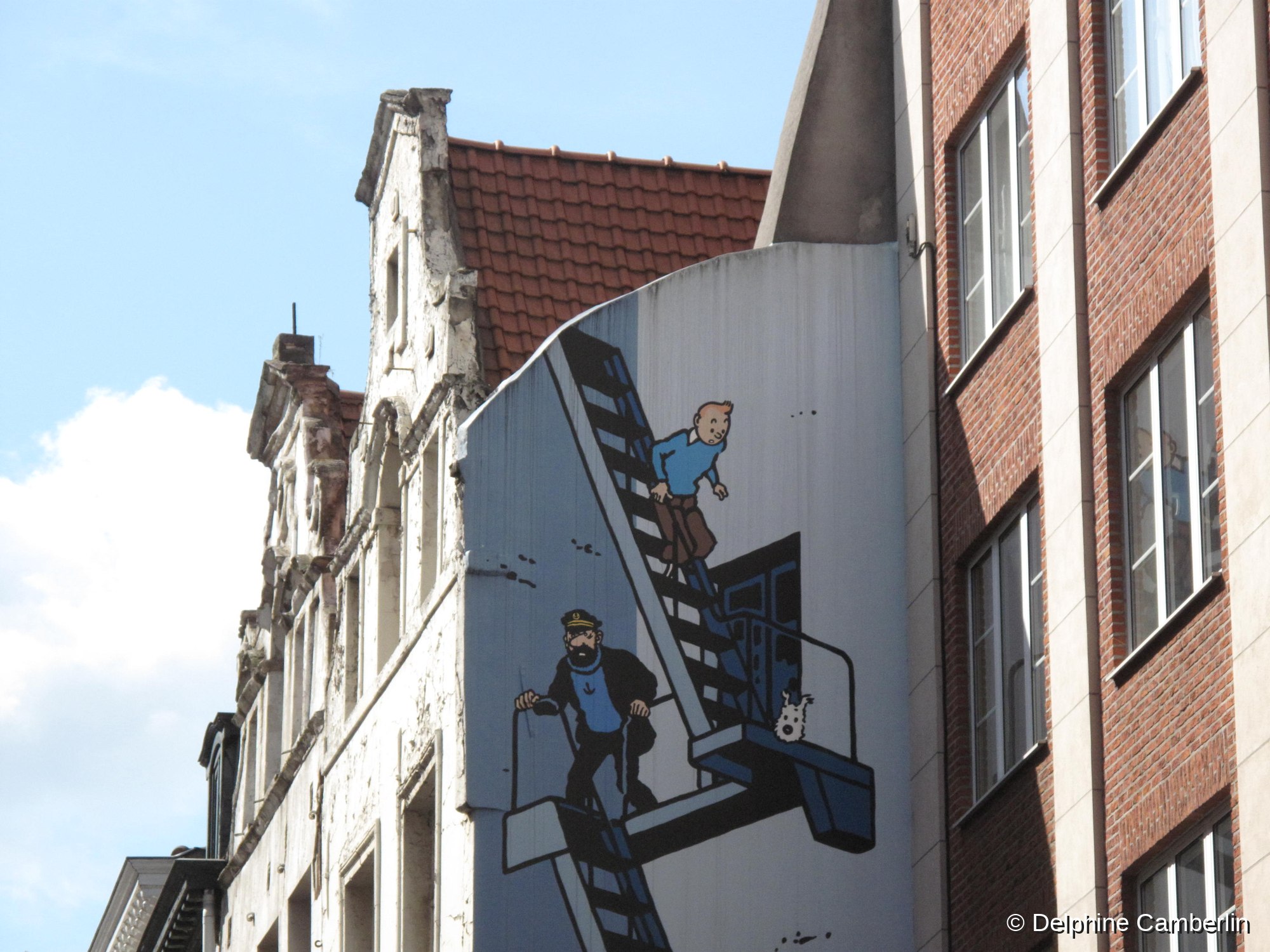
Painting. The Belgian artistic tradition runs extraordinarily deep — from Jan van Eyck and Pieter Bruegel the Elder in the Flemish Golden Age, through the surrealist genius of René Magritte (whose bowler-hatted men and floating green apples remain some of the most instantly recognisable images in modern art), to the Symbolist James Ensor and the lyrical abstractions of Paul Delvaux. The Royal Museums of Fine Arts in Brussels hold one of the finest permanent collections in Europe.
Architecture. Victor Horta almost single-handedly invented Art Nouveau as an architectural language — his Brussels townhouses, now UNESCO World Heritage Sites, curve and flow with an organic logic that still feels radical. The Atomium — a 102-metre structure built for the 1958 World Exposition representing an iron crystal magnified 165 billion times — is that rarest of things: a mid-century landmark that has aged into genuine icon status.
● Beer tourism — Belgium has over 1,500 beers and more distinct styles than any other country. The Delirium Café in Brussels holds the Guinness World Record for the largest beer menu (over 2,000 references). Trappist beers — brewed by monks under strict rules — include Chimay, Orval, Rochefort, Westmalle, Westvleteren, and Achel. A brewery visit — particularly to Chimay in the Ardennes or the extraordinary Cantillon lambic brewery in Brussels — is an experience of genuine depth. The Belgian beer culture is UNESCO Intangible Cultural Heritage.
● Chocolate factory visits — Belgium produces around 220,000 tonnes of chocolate per year, and Brussels Airport is reportedly the world's single largest chocolate sales point. The great Belgian chocolate houses — Neuhaus (inventors of the praline in 1912), Godiva, Côte d'Or, Leonidas — are internationally known, but the real treasure is in the small independent chocolatiers: Pierre Marcolini in Brussels, Dominique Persoone in Bruges, and the dozens of small artisan producers whose pralines, ganaches, and mendians are made fresh daily.
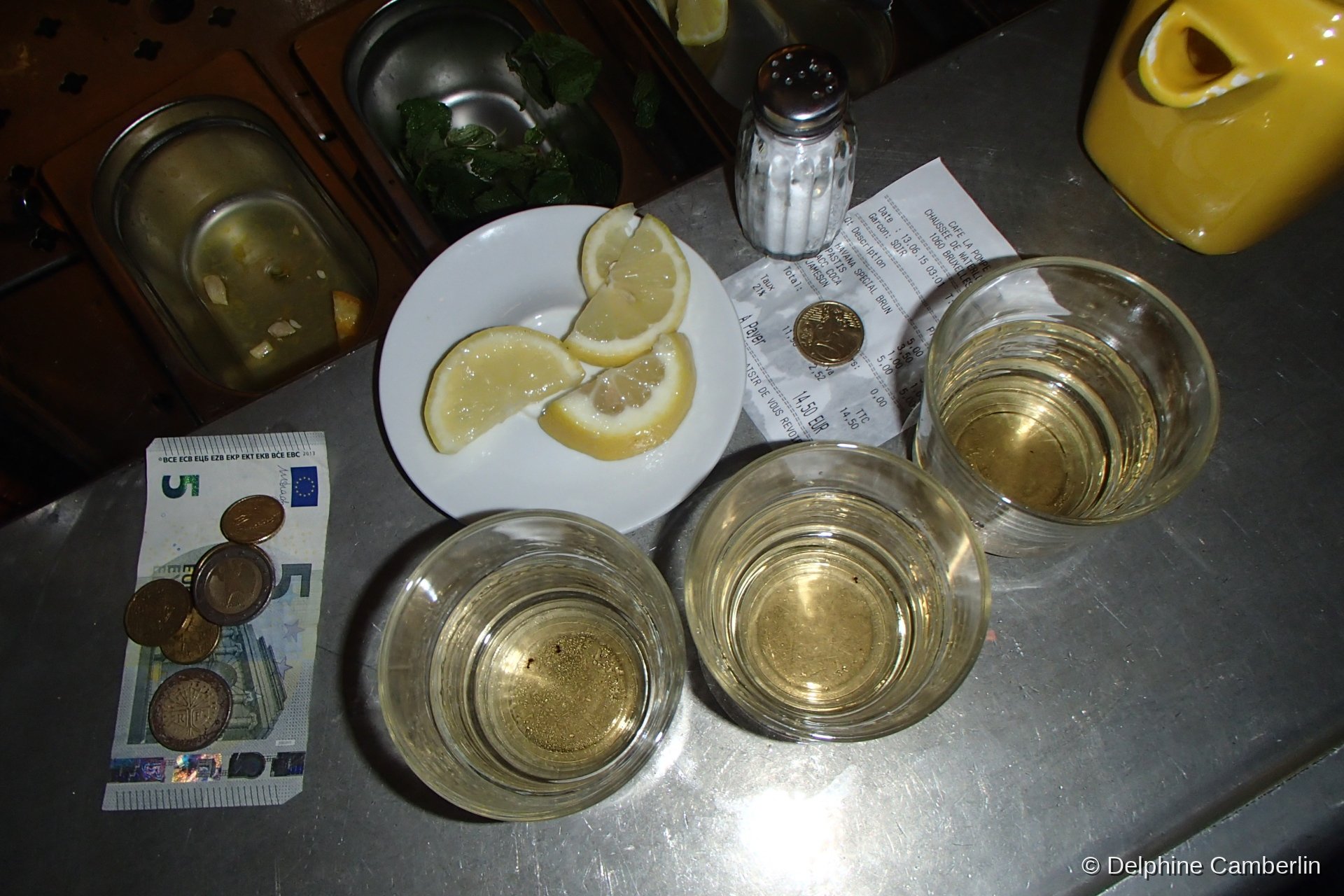
● Les Fêtes de Wallonie — Namur in September — if you want to understand what Wallonia actually feels like from the inside, this is the festival to attend. Every September, the city centre of Namur is closed to all traffic for several days as the entire population takes to the streets to celebrate Walloon culture with an intensity that has to be witnessed to be believed. Peket flows freely — shots of genever poured from bar counters that spill out onto pedestrianised squares — bands play on every corner, folklore processions wind through the old town, and the citadelle district above the city rumbles with music until late into the night. It is loud, warm, chaotic, and completely genuine. The Walloons don't perform their culture for tourists — they simply live it, and you happen to be there.
● Christmas markets — Belgium transforms in December. The Brussels Winter Wonders market around the Grand-Place is spectacular. The Marché de Noël in Liège draws hundreds of thousands of visitors to the banks of the Meuse. But the most charming is the Marché de Noël Féerique de Ciney — a beautifully intimate market in the Condroz region that feels entirely handmade and genuine, the polar opposite of the corporate Christmas markets of the big cities.
● La Flamiche 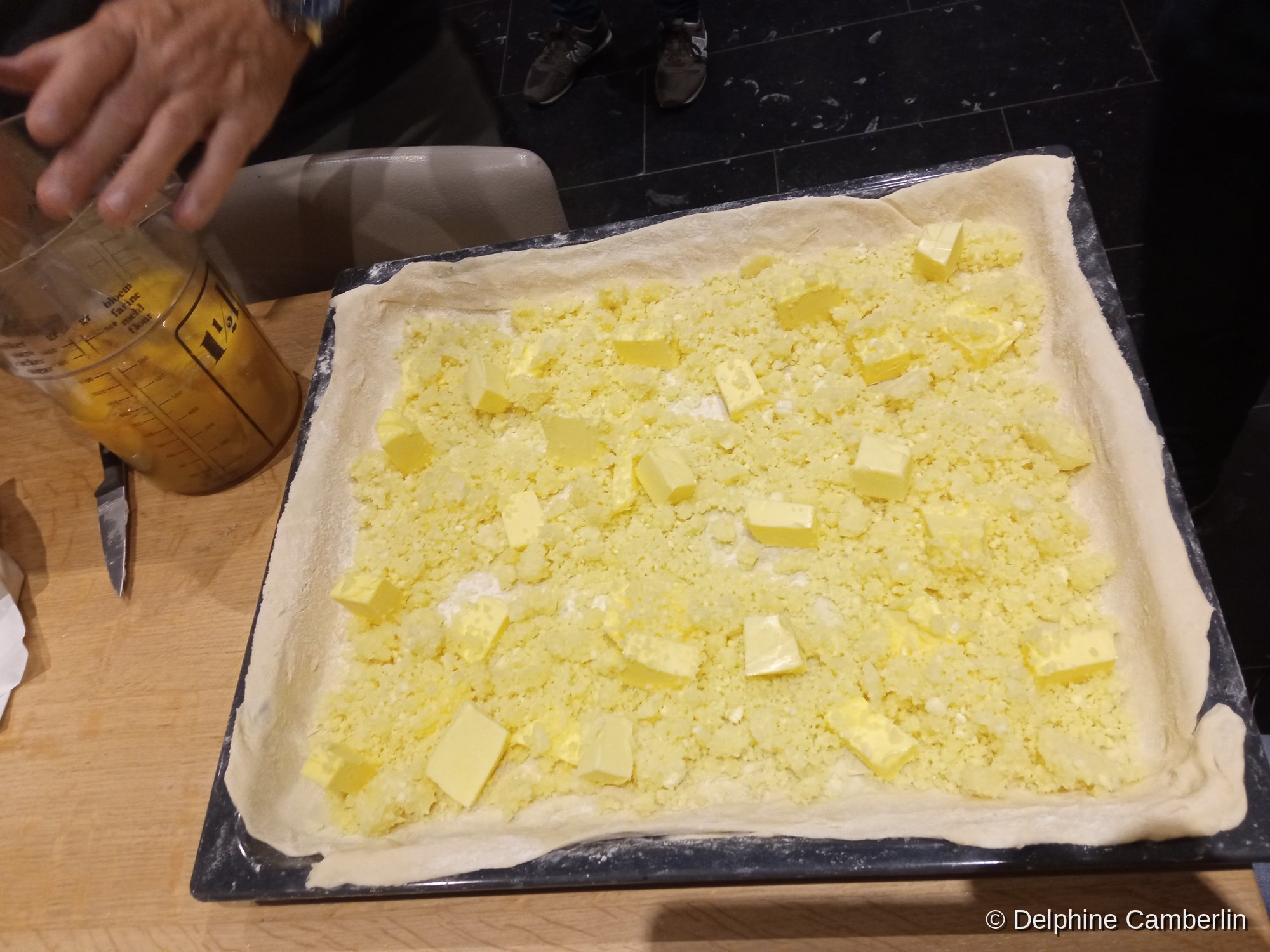
● La tradition du muguet le 1er mai — every 1st of May, lily of the valley appears at every street corner. Giving muguet to the people you love on May Day is a Belgian tradition of great warmth.
● Soirées rock & salsa — Belgium has a vibrant live music culture beyond its famous festivals. Bars in Saint-Gilles and Ixelles host regular rock and salsa evenings; in smaller Walloon towns, Saturday night means a local band and dancing until midnight.
● La chasse — hunting is a deeply rooted tradition in the Ardennes, and the autumn hunting season (la chasse) shapes the rhythm of rural Wallonia in ways that visitors rarely see. Local restaurants serve wild boar, venison, and pheasant in season — a gibier menu in an Ardennes country restaurant in October is one of Belgium's finest culinary experiences.
● Battlefield history — Belgium carries the weight of two World Wars more heavily than almost any other country. The battlefield landscapes around Ypres (Ieper) in West Flanders — the Menin Gate, Tyne Cot cemetery, the In Flanders Fields museum — are profoundly moving. The Lion's Mound at Waterloo, south of Brussels, marks the site of Napoleon's final defeat in 1815: a 40-metre artificial hill topped by a cast-iron lion, from which the panorama of the battlefield spreads in every direction. The Bastogne War Museum in the Ardennes commemorates the Battle of the Bulge with remarkable depth and restraint.
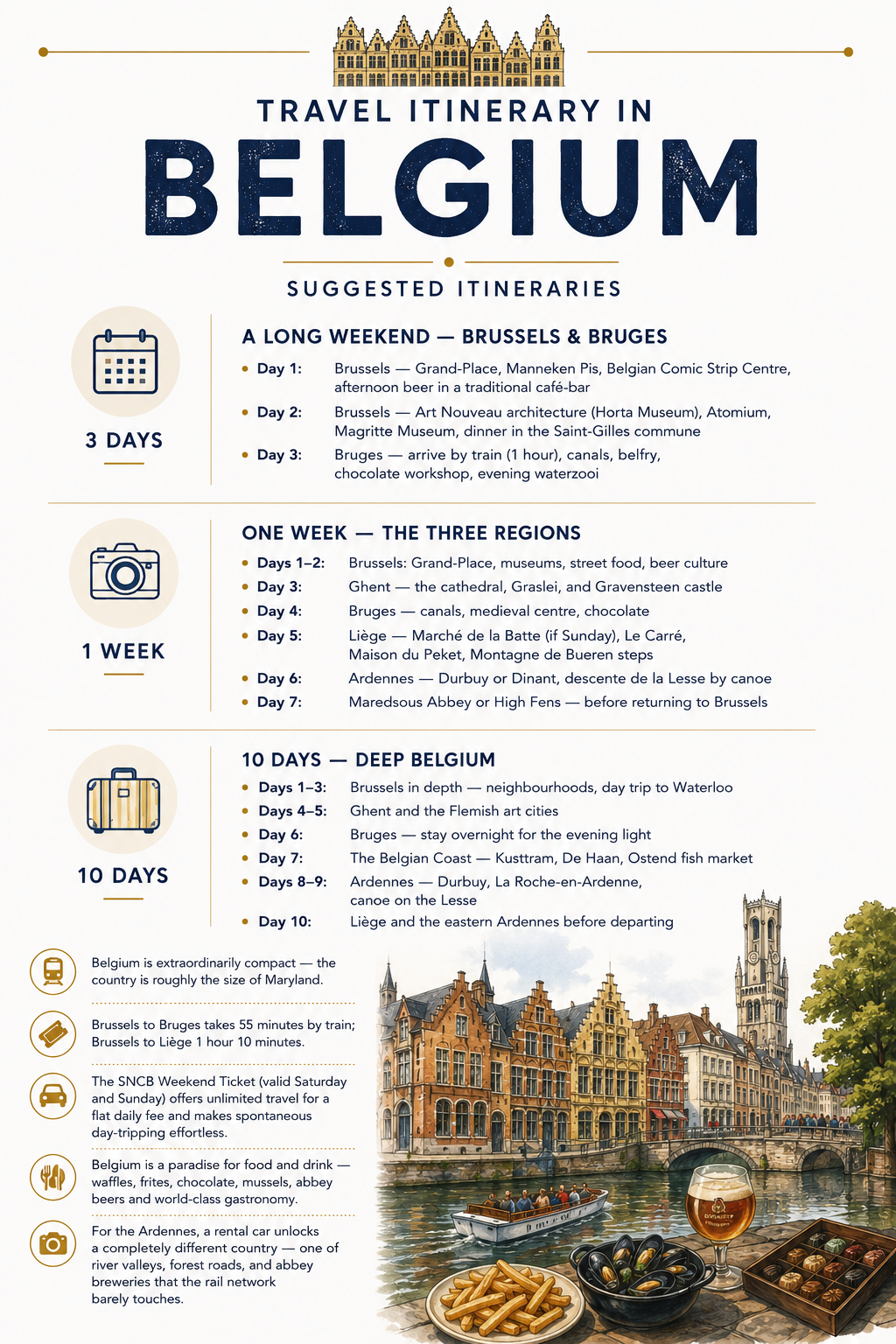
Belgium is extraordinarily compact — the country is roughly the size of Maryland. Brussels to Bruges takes 55 minutes by train; Brussels to Liège 1 hour 10 minutes. The SNCB Weekend Ticket (valid Saturday and Sunday) offers unlimited travel for a flat daily fee and makes spontaneous day-tripping effortless. For the Ardennes, a rental car unlocks a completely different country — one of river valleys, forest roads, and abbey breweries that the rail network barely touches.
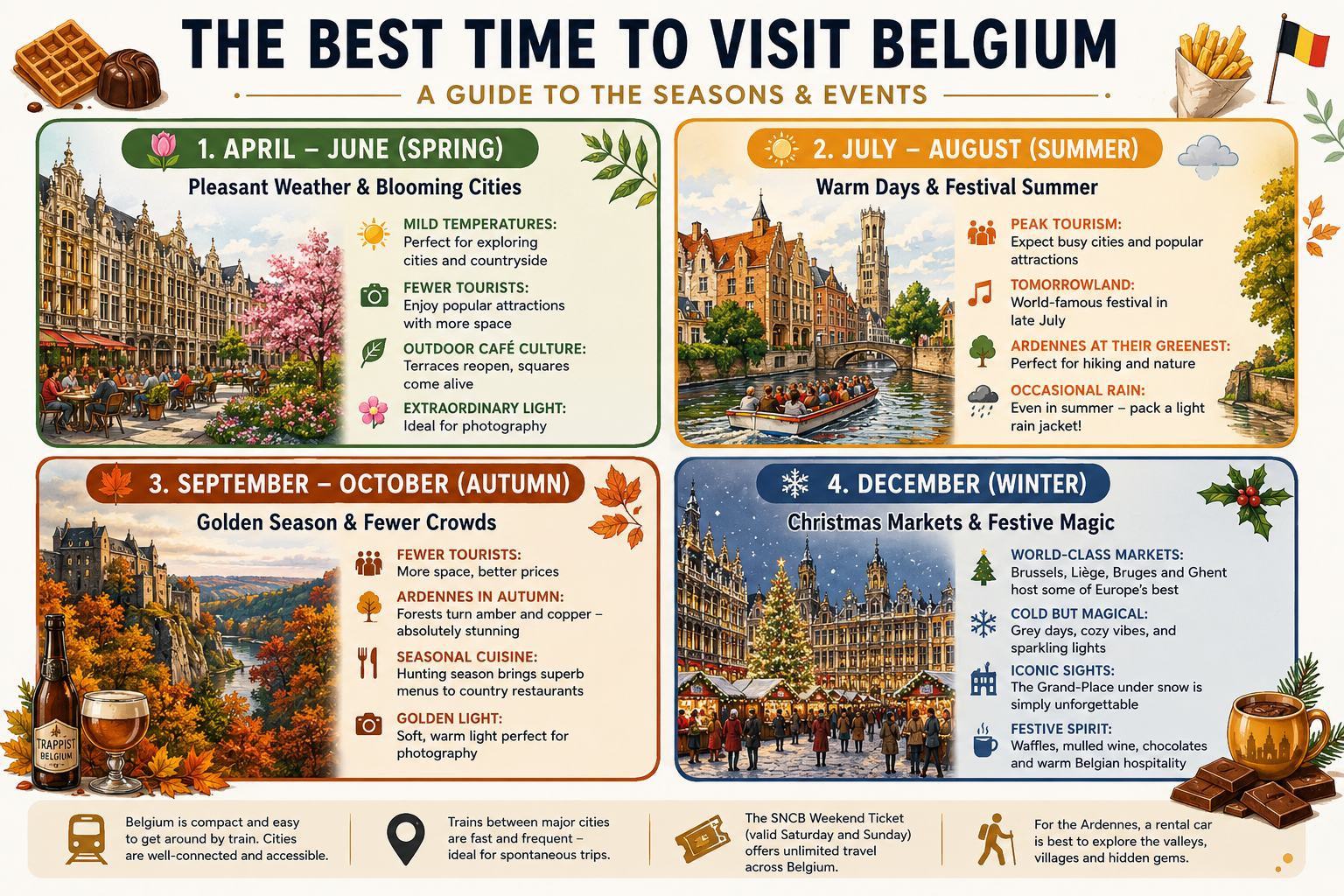
Spring is Belgium at its most pleasant — mild temperatures, long days, blooming parks, and the festive energy of outdoor café culture returning to city squares. Fewer tourists than summer, and the light is extraordinary for photography.
Summer brings warmth and long evenings, but also the peak of tourism in Bruges and Brussels. Tomorrowland takes place in late July. The Ardennes are at their greenest. Expect occasional rain even in the warmest months — this is Belgium, not the Mediterranean.
Arguably the finest time to visit. The crowds have thinned, the Ardennes forests turn amber and copper, the hunting season brings superb seasonal menus to country restaurants, and the light has that soft golden quality that makes every street scene worth photographing.
Belgium transforms for Christmas — the markets at Brussels, Liège, Bruges, and Ghent are among Europe's finest. Cold and grey, but deeply festive. The Grand-Place under snow is one of the most beautiful sights in Europe.
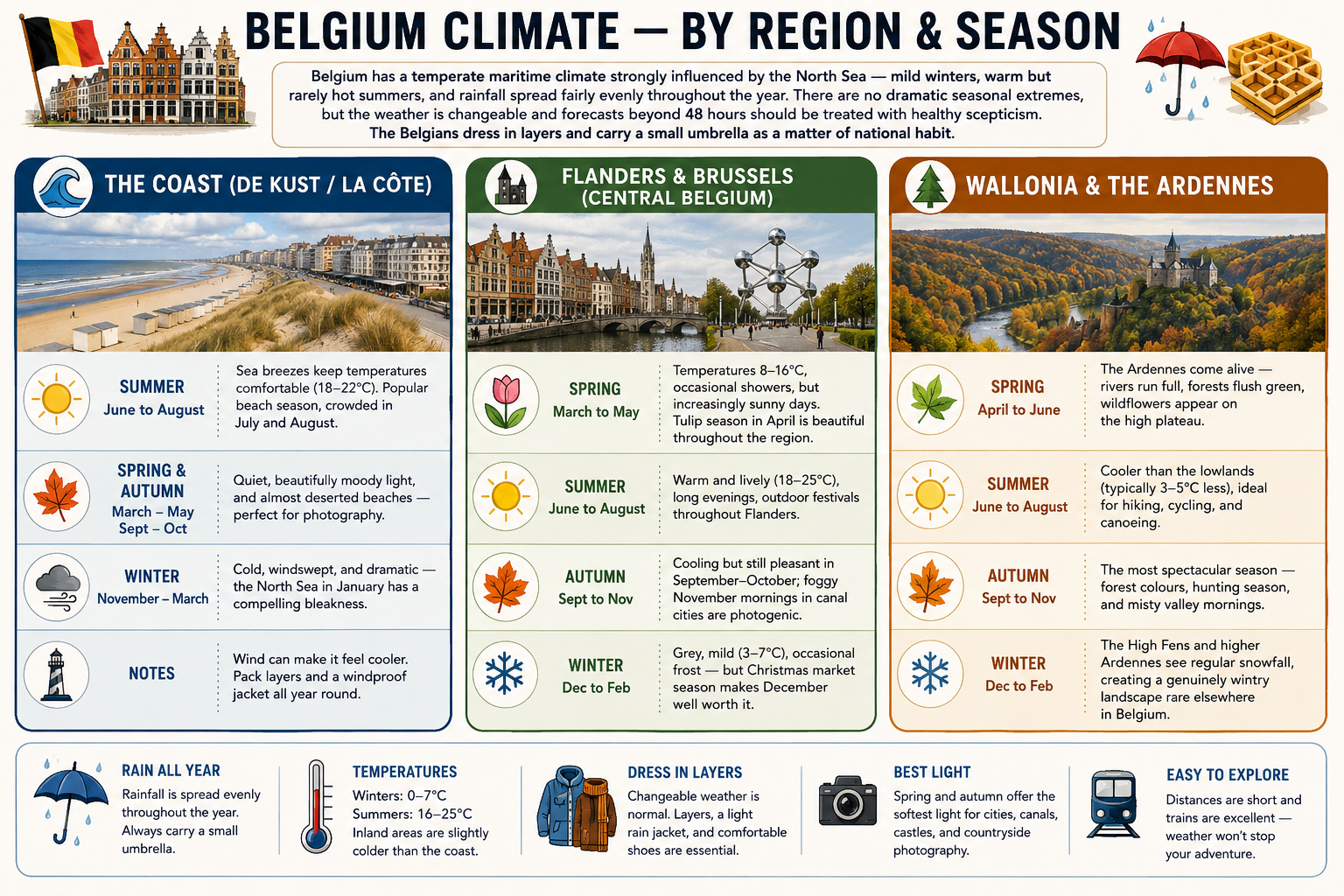
Belgium has a temperate maritime climate strongly influenced by the North Sea — mild winters, warm but rarely hot summers, and rainfall spread fairly evenly throughout the year. There are no dramatic seasonal extremes, but the weather is changeable and forecasts beyond 48 hours should be treated with healthy scepticism. The Belgians dress in layers and carry a small umbrella as a matter of national habit.
Summer — June to August
Sea breezes keep temperatures comfortable (18–22°C). Popular beach season, crowded in July and August.
Spring — March to May
Temperatures 8–16°C, occasional showers, but increasingly sunny days. Tulip season in April is beautiful throughout the region.
Spring — April to June
The Ardennes come alive — rivers run full, forests flush green, wildflowers appear on the high plateau.
🎟️ GetYourGuide: "Experiences I'd book in Belgium: a Brussels chocolate atelier, a guided Bruges evening canal walk, a Trappist brewery tour, and a World War I battlefield guided visit around Ypres."
Stock Photography
Browse and license the Brussels & Belgium cities photography collection — available for commercial and editorial use on Shutterstock.
View on Shutterstock →
Stock Photography
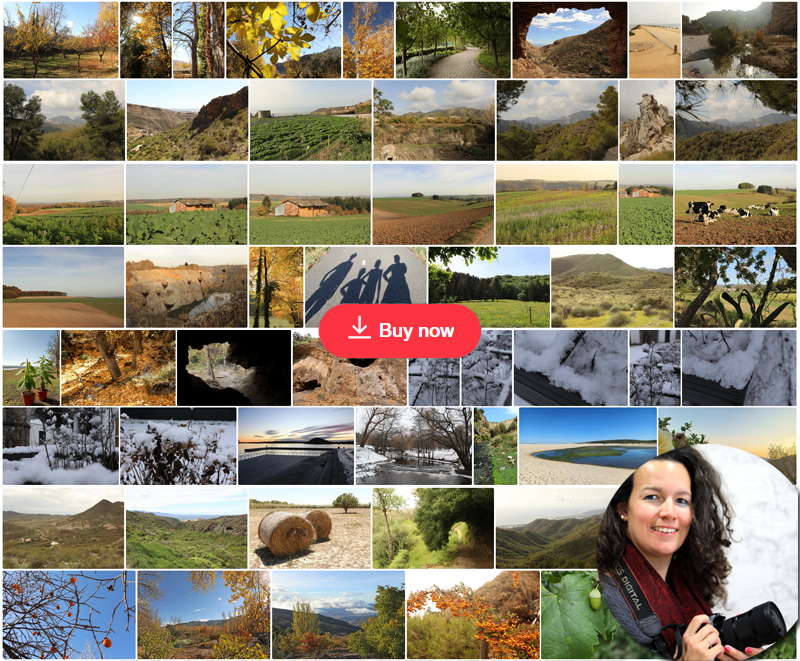
Browse and license the Belgium nature & Wallonia photography collection — available for commercial and editorial use on Shutterstock.
View on Shutterstock →